
Genre: Graphic Adventure Developer: Darts: Publisher: Hot-B Players: 1 Released: 1992
I think I first saw Detonator Orgun back in college, at one of the all-day anime fests the local university club held each semester. That was back in the day when most series were only a few episodes and something you could watch in a single sitting. Detonator Orgun was a three-episode OVA (original video animation) that was fun but not mind-blowing, but anime was something that seemed to get a video game rendition in Japan no matter the quality, so it wasn’t surprising that one was made. I remember feeling intrigued at the previews of the Mega CD release in game magazines, since such releases weren’t common in the U.S. at the time and especially on Sega consoles. Sadly, I didn’t have a chance to play it until years later. I suppose I didn’t miss much considering that I wouldn’t have been able to play it anyway because it was entirely in Japanese.
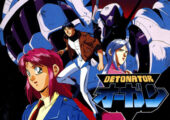
Originally released on July 31, 1992, in Japan only, Detonator Orgun was a visual novel/adventure game by HOT-B Co. Ltd., a game that was an adaptation of the 1991 anime OVA series of the same name. The story revolved around a university student in City No. 5 named Tomoru Shindo and how he got involved with Orgun, a mechanized knight of the Evoluder race. Orgun, to be exterminated by his own kind, telepathically contacted Tomoru after a battle on the Moon. This contact set off a chain of events between Earth’s Defense Force and the looming threat from the Evoluders. The story was a close adaptation of the first two episodes of the anime, culminating in a preview of the third.
If you’ve ever seen the anime, then you know that it is not your typical “guy in giant mech shoots other mech” tales. It was a slow burn, and I mean slow. The first episode was a dragged-out origin story, and when the plot finally picks up, it’s not really worth the price of entry. I can think of several other mech-based anime that were more worthy of an adaptation, but whatever; it is what it is. Detonator Orgun on the Mega CD worked with what it had, and what it had was story… lots and lots of story. It was weird and all over the place, but it was oddly kind of fun.
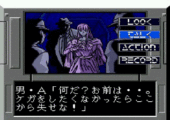
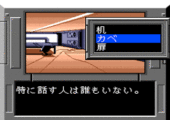
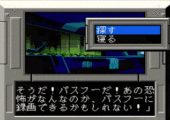
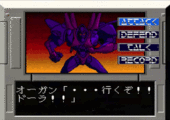
The most apparent thing at the beginning was the heavy emphasis on that storytelling. As a game, Detonator Orgun did not have any action sequences at all but was rather based on advancing the story through dialogue and decision-making using a point-and-click interface, much like other graphic adventures on the Mega CD. A bit slow, it provided players with “Look,” “Think,” “Talk,” and “Move” as their options for interacting with the world and its characters. This made it closer to Snatcher and The Space Adventure than action games, so players looking for hectic mech-based shooting action were going to be disappointed. Detonator Orgun was an exploration by way of narrative style but at the expense of accessibility because the game’s text was entirely Japanese. While there were bound to be some who could muddle their way through it, native speakers of other languages faced a considerable obstacle to enjoyment before being able to experience the full thing.
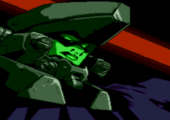
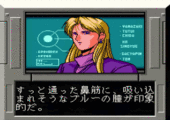
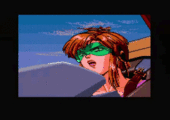
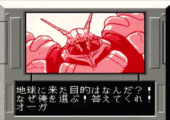
Detonator Orgun’s presentation was something of a mixed bag. Its FMV cut scenes were from straight-out-of-the-source material from the original anime, but of compressed video quality and Japanese voice acting with no subtitles. Those scenes were impressive for their time in terms of scope, but they were plagued by pixelation and limited color range, giving the whole game a faintly fuzzy appearance. Despite this, the environment was fantastic. The graphics, while not the sharpest, at least did a good job of achieving the cyberpunk aesthetic of the source material. The game was a pretty accurate reflection of the cyberpunk appearance of the original anime.
The only real problem – surprisingly for a CD-ROM game – was the audio. Synth-saturated composer Kouji Hayama’s score boomed with dramatic power, matching the sci-fi atmosphere well throughout the adventure, and that was terrific, but it was a shame that the rest of the audio wasn’t as consistent. Detonator Orgun started off with an animated intro with CD-quality voice, music, and sound effects, but as it progressed the voice became less frequent and scratchy for some reason, and the music transitioned from CD audio to the YM2612-generated chiptunes of the Mega Drive. I have to say that this was a major disappointment, as the only thing the Mega CD seemed to be doing was the voice work (of which there is much). Take that away, and there was no reason Detonator Orgun couldn’t have been a cartridge release.
Detonator Orgun was a faithful-to-life port of its anime original, giving fans an interactive window into the series. In all honesty, I think such faithfulness hurt the game more than anything else. The anime wasn’t all that exciting, and that made the transition to console intact. Additionally, the lackluster production value hurt it even more, and it was kind of a self-inflicted wound. There was no reason for the audio to be so disappointing. I’d at least expect great sound from a CD-ROM game of this era to be the one box I could check. Sadly, Detonator Orgun’s production value just screamed “quick cash in” and given all the great anime-based games from this period, there was no excuse for such mediocrity. I wholeheartedly recommend playing Urusei Yatsura: My Dear Friends instead.
That being said, those who aren’t familiar with the series will get even less value (maybe video scenes of cool mechs fighting might be enough. but can’t you just watch the anime for that?). I’m sure that its excessive reliance on Japanese text, however, and lack of action-oriented gameplay certainly limited its appeal to a broader audience. If you don’t know Japanese. I strongly recommend using a YouTube walkthrough like this one or spend the majority of the time going through each menu item one by one until you find the correct one. The language issue and lack of action might not be as important today for fans of the OVA, but just about everyone else will struggle to maintain interest beyond the few cool cut scenes in the opening intro.
SCORE: 6 out of 10
Recent Comments