
Genre: Shmup Developer: Sega Ent. Publisher: Sega Ent. Players: 1-2 Released: 1982
1982 was a big year for Sega. Its North American arcade group, Sega/Gremlin, changed its name to Sega Electronics. It also started to release software for home consoles like the Atari 2600 and ColecoVision. Both elements would combine after Sega began an effort to develop video games around Paramount Pictures’ brands, a result of it still being owned by Gulf + Western at the time (it was transferred over from the conglomerate’s manufacturing arm in December 1981). The movie studio wanted to bring some of its biggest properties, like Star Trek, to consoles quickly, and having an arcade powerhouse like Sega under its roof made that decision much more feasible starting a new studio or licensing franchises to outside developers, which is what Paramount’s competitors MCA and 20th Century Fox did.
More than a half-dozen movie-based games were planned for properties that included Dragonslayer, Friday the 13th, and War of the Worlds. Only two would ever see an actual release, the stellar Star Trek: Strategic Operations Simulator, and Buck Rogers: Planet of Zoom. While the former was a direct attempt to specifically emulate the movie’s intense space battles, the latter kind of… well, tries a little bit of everything. It’s a competent game and quite fun, but it has, well… buck-all to do with Buck Rogers. Seriously, beyond the name, there is nothing here that has to do with the property. Sega obviously slapped it on to give the game some quick brand recognition, opting to rebrand one of its Japanese-made games, Zoom 909, rather than develop one from the ground up.
Not that I fault that. Honestly speaking, it did make sense to use the license. By the early 1980s, Buck Rogers had already become an American pop culture icon. He had spent decades starring in novels, comic strips, radio serials, films, and television shows since first appearing in 1928. Although he wasn’t as well known in Japan, U.S. audiences would recognize him immediately; particularly after a film revival in 1979 and a series that ran for 37 episodes from 1979-1981. There had never been a better time for ol’ Buck to make the jump into interactive entertainment, so when Sega released Buck Rogers: Planet of Zoom at the close of 1982, the partnership felt right. An already popular space hero combined with an action-based game seemed like easy money, and those who had grown up with the franchise were already prepared for some fast-paced science fiction fun.
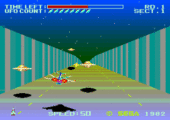
Timing aside, Buck Rogers: Planet of Zoom’s release wasn’t just centered around the character’s revival. Science fiction in general was booming in movies and games during this period (just count how many Atari games have the word “star” in them). Sega was absolutely thinking about capitalizing on the cultural phenomenon surrounding the Star Wars movies, as well as the success of the new Star Trek sequel. Unfortunately, that eagerness may have caused some people to think that Planet of Zoom is merely a Star Wars knockoff because of its first stage, which bears more than a passing resemblance to the iconic Death Star attack scene from A New Hope.
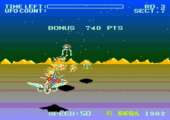
I’d wager those people are putting a bit too much thought into Planet of Zoom’s design. There’s a definite inspiration here, of course, but it’s not full-on plagiarism. Rather, Sega takes elements from some of the popular sci-fi lore that we know and love and brings into a quasi-3D environment that was damn impressive at the time to give players that sense of dog-fighting in space. The hardware Planet of Zoom runs on, Sega’s VCO (Voltage Controlled Oscillators) Object system, is perfect for creating this immersion. It’s the same architecture that powered its hit Turbo and was the precursor to Sega’s Super Scaler classics like OutRun and After Burner. As only Sega’s second attempt at scaling sprites to create the illusion of 3D, the VCO isn’t quite as powerful as that system, but it works well enough to create some visually stunning and engaging battles that seem to run at breakneck speed, especially for those lucky enough to play in the cockpit cabinet with its neat control stick.
The game’s plot isn’t trying to follow George Lucas, either, but it also doesn’t attempt to follow any of the character’s known adventures. A giant destructive world called the Planet of Zoom barrels through space, devastating all in its path. Buck must stop the planet by flying to it and destroying its leader, the Source Ship. It’s simple, straight to the point, and utterly irrelevant, like the plots of most other shooters. All I want to know after I insert a quarter into the cabinet is when I can start shooting things.
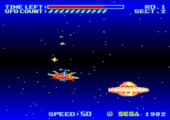
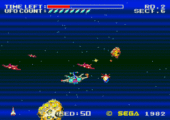
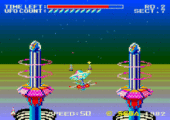
The answer in Planet of Zoom is: “pretty quickly.” The action starts immediately, but each of the eight multi-area sections that compose each round is short, which is a bit of a bummer for me since I really like how they look. Sega put a bit of effort into varying them but there isn’t much of a chance to enjoy the scenery because there’s a red bar at the top of the screen that shows how much time remains until Buck moves on to the next one. Players have a bit of control over how fast it empties, controlling Buck’s starfighter from a rear perspective and traveling at two different speeds, fast and slow, that are switched via an accelerator pedal. The faster he flies, the less fuel that is consumed. Zipping (zooming?) through each section is a great way to score extra points, but it’s also vital for advancing through sections because when Buck’s fuel runs out, he crashes and dies. Navigating at maximum speed awards additional bonus points but makes it increasingly difficult to maneuver the fighter, given the already hectic pace of the game. The sections have four different enemies to fight, as well as obstacles like walls and energy towers, and ultimately, there’s a boss battle with the Source Ship, which can be destroyed by taking out its four engines.
However, once the initial “wow” factor has faded, Planet of Zoom has some problems. Most obvious is its reliance on superficial ties to the Buck Rogers franchise, but the biggest issue is its repetitive nature. The game’s failure to reset the score when adding additional credits diminishes the whole point of going after high scores and hurts any competitive aspect of the gameplay. All those points don’t mean much if you can just keep feeding the machine quarters to inflate them. Moreover, because it only has five short stages, Planet of Zoom’s indefinite looping structure ultimately takes away any momentum and engagement from the initial impression, leaving players bored after a while and sci-fi fans highlighting how Sega missed opportunities for innovation and variety. I guess being an arcade game kind of excuses the repetitiveness since most arcades probably had the difficulty high enough to try and keep people from doing multiple loops on a single quarter, but the gameplay isn’t much deeper than its ties to the name it uses.
Repetitiveness aside, something I can give Planet of Zoom a bit of a pass on because of its early arcade nature. I think Sega succeeds, for the most part, in its mission to leverage the popularity of our childhood sci-fi favorites into a fun little space romp. In 1982, it was a real showstopper when you saw it on the game room floor, but it was also one of the pioneers of integrating media franchises into video games. Such practices were quite new, with a few earlier examples (like Sega’s own Fonz), but Buck Rogers was a classic franchise, and along with Star Trek: SOS, Sega had two big sci-fi hits to please fans. I think that’s how Planet of Zoom should be considered; a fast-paced space combat alternative to Star Trek’s more tactical battle simulations. Taken for what it is, the game can be fun and intense for a while.
The original arcade version is quite hard to find in coin-op form now, and while there are lots of console and computer ports out there, the best way to play is definitely the cockpit cabinet. The others can’t recreate the scaling effect as fluidly, which is a major part of the game’s identity, and the control stick makes a ton of difference. Planet of Zoom isn’t as nuanced as Star Trek: SOS or as memorable as Zaxxon, but it does strike a decent balance between nostalgic appeal and innovative gameplay mechanics to give players a memorable arcade gaming experience. I don’t think there’s much more you could have asked of it.
SCORE: 6 out of 10

Recent Comments