
Genre: Shmup Developer: Sega Ent. Publisher: Sega Ent. Players: 1-2 Released: 1982
I grew up in arcades, Seriously, I think I spent more time at my local Aladdin’s Castle and Circus Playhouse than I did with my parents. Those places fascinated me – they still do – and I marveled whenever a new machine arrived. I loved shooters and, having become quite proficient in the likes of Stargate, Gorf, and Galaxian, I was excited when I saw Sega’s new game Zaxxon on the game floor at Circus Playhouse. It had a real Star Wars vibe to it, with the whole “penetrate the base’s defenses and destroy it” motif. Then again, I was nine, so everything had a Star Wars vibe to it in some manner. Still, the game looked so different from the vertical and side-scrolling shooters I was used to playing. What new type of gameplay would I have to master? What kind of awesome graphics would it have? Zaxxon answered both those questions without hesitation or mercy: it was the kind of game that kicks your ass and the kind that blows your mind.
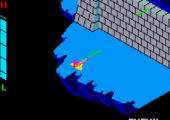
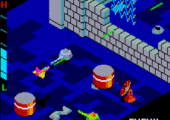
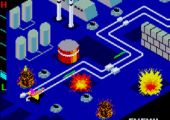
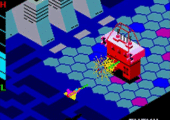
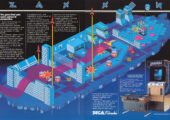
And it did indeed blow my mind. Back when Zaxxon was released in 1982, it stood out from other shmups with its innovative perspective, offering players a simulated 3D flight experience that set it apart. Unlike traditional 2D games like Defender, Zaxxon introduced an isometric viewpoint (the first one to do so), providing players with a unique sense of depth and immersion. The controller was a flight stick, and you could move up and down as well as to the sides! I’d never seen anything that incorporated altitude into its gameplay before, and I was enthralled. However, I must admit that while this perspective was groundbreaking at the time, It wasn’t quite as effective in practice, and ultimately, I think it contributed to what made the game so frustrating early on.
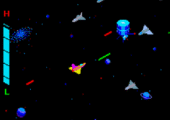
Zaxxon started players in space, where they had to battle waves of oncoming ships. It seemed pretty simple at first, until those ships started to move vertically. Suddenly, most of your shots missed, and the challenge shifted from destroying the enemy to raising or lowering your own ship to avoid their attacks. Sure, the control panel explained how the altitude meter works, but nine-year-old me never read those things! I always relied on the attract mode to learn how to play, and during the short time I watched, Zaxxon made the control look easy. Boy, was I wrong!
Navigating through Zaxxon’s obstacles and enemies proved to be a daunting task, exacerbated by its difficult controls and limited visual cues. It wasn’t easy to get the hang of using that stick to raise and lower the ship, and it took me a few plays to realize that my ship’s bullets could be used to gauge the height of spaces and barriers. The game moved at a quick pace, leaving little time to maneuver. Additionally, the constant draining of the fuel meter added another layer of complexity, restricting players from freely exploring the game’s environments and even distracting them from the gameplay. Hitting those fuel tanks was essential, and they were often diabolically placed so that one would swoop down or over to get them and not have enough time to move away from an oncoming wall or radar dish. These kinds of dangers were the biggest challenge to learning how to play Zaxxon, and despite attempts to aid players with visual indicators such as shifting sprite sizes and altitude meters, determining the precise position of the ship remained a struggle, leading to frequent collisions and failures.
Even with years of gaming experience, returning to Zaxxon today can still be a test of patience and skill, a sobering realization for those newcomers who bought it on the Nintendo Wii eShop when it appeared in 2010. The game’s unforgiving design, particularly in its later stages, make progression difficult and can often become frustrating. As an early 1980s shmup, the high score was the goal for most people, but that might not entice modern players. Zaxxon only has three stages and a single boss battle, so they might not find it meaty enough. Personally, I give Zaxxon a pass in that regard because it’s a product of its time, and anyone playing it needs to realize that. My main complaint when playing the home version on console or via emulation is that using a D-pad to play isn’t as immersive as the flight stick of the original arcade cabinet. If you don’t have one for your console, you’re stuck with a control option that kind of goes against what made Zaxxon such a fun and unique experience in arcades.
Sadly, no further installment ever matched the same level of quality as the original. The sequel, Super Zaxxon wasn’t as good, and the Motherbase 2000 on 32X didn’t make any real impact, so it’s unlikely that the franchise can resonate with today’s audiences who may not have even heard of it. I still love the game and play it every so often, but I was there when it was new, so nostalgia acts as one hell of a glaze. I know that many players may play it for the first time on console or PC, but doing so without a control stick may taint their impression. I urge anyone who wants to get the full experience to play the arcade original or at least get a control stick for their home machine.
In the end, your mileage will definitely vary with Zaxxon. It may have been a staple of arcade gaming in the early 1980s, but its difficulty and lack of depth may not be enough to overcome its innovation and creativity for some players raised on a diet of modern shmups. I recommend they play Zaxxon in the context of its original release and try to enjoy it that way. There is fun to be had, and as old school shmups go, Zaxxon has an amazing look and hard-as-nails gameplay that will take quite some time to master.
SCORE: 8 out of 10
Recent Comments