
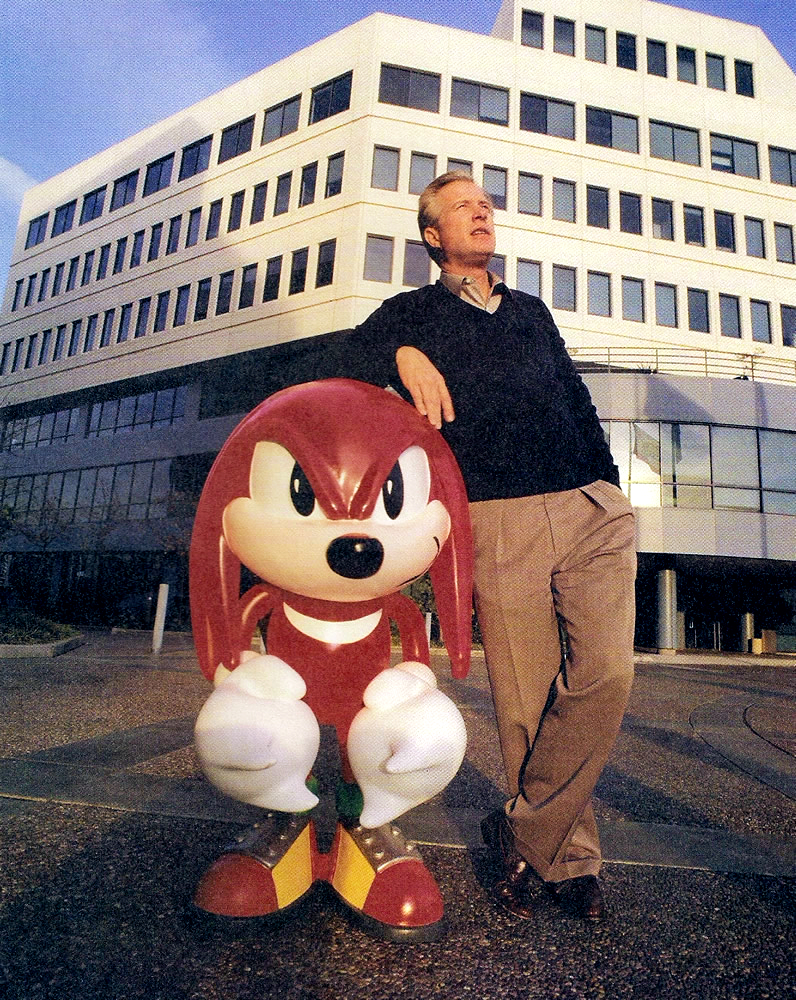
Ask just about any gamer what the single worst problem there is at Sega and their answer will almost always be the same: management. No other game company has had such a tumultuous history when it comes to just who was running the show, and there have been four presidents in the last decade alone. It has been a problem that has plagued the legendary software developer since the mid 1990s, when then-president and CEO Tom Kalinske was forced out due to a series of questionable business decisions by Sega of America. The events surrounding his departure were the first visible domino in a chain effect from which the company never recovered, and eventually led to their exit from the hardware business in 2001.
For years, many have contended that Sega’s misfortune during the Saturn and Dreamcast eras was directly related to its mistreatment of Kalinske, but it becomes quite obvious that there was so much more to it once you examine the facts. We must certainly give Kalinske credit for his achievements. No other president before him ever gave Sega the level of success he did, and none since have ever equaled it. One could even go so far as to say that Sega lasted as long as it did as a hardware manufacturer thanks to Kalinske’s efforts during the 16-bit era.
That being said, there were many issues within Sega of America that would contribute to its troubles, many of which were related to how much Genesis inventory was piling up in Sega’s warehouses at the end of the 16-bit era. Recent information provided by former Sega Vice-President Shoichiro Irimajiri, who became President after Kalinske’s departure, reveal more information on the financial problems that plagued Sega of America.
Toppling the Nintendo Beast
Flashback to 1990. Sega of Japan’s lord and master, Hayao Nakayama, was busily readying the debut of the company’s new mascot: Sonic The Hedgehog. The Blue Blur was part of a two-pronged approach to taking on rival Nintendo. The new corporate mascot would be backed by a huge advertising campaign that would throw as much cash as humanly possible at promoting both the game and the Genesis. Though Sega’s new console had sold more than half a million units in America, Nakayama was beginning to feel desperate (a feeling that he would soon get used to) and fired Sega of America president Michael Katz, replacing him with Tom Kalinske. He was well aware that his new candidate, a graduate of the University of Wisconsin (who also has an MBA from the University of Arizona) and former president of Mattel, could make the Genesis a success and wrest away control of the gaming market from the industry’s 800lb gorilla. At Mattel, Kalinske had taken the moderately successful Barbie line of toys and transformed it from a $42 million dollar franchise to a $1 billion dollar a year juggernaut. He had successfully guided the company through the “crash” of 1983 by turning their electronic division into a separate entity – Mattel Electronics. If there was anyone who could turn the Genesis into a hit, it was Tom Kalinske. While not a veteran of the gaming industry, Kalinske was a fast learner who surrounded himself with highly capable people who knew the ins and outs of video games.
After quick and careful study of Sega’s established marketing strategy, SOA’s new president set off to Japan to inform Nakayama that a change in tactics was needed. He wanted to continue to tackle Nintendo head-on and directly compare the Genesis to the SNES through a slick new advertising campaign. Though Katz had been the originator of the strategy with his Genesis does what Nintendon’t campaign, Kalinske felt Sega needed to go for the throat. It wasn’t enough to simply compete directly with Nintendo; the competition needed to be humbled, ridiculed, and portrayed as having the inferior product. Nakayama, who was not accustomed to such a philosophy, didn’t understand. Moreover, Sega’s board of directors practically called for the upstart American’s head. In the end, however, the ruler of all things Sega was convinced and gave Kalinske his full support. Kalinske himself recalls how events unfolded during that fateful trip to Japan:
After my first month as CEO, I told Mr. Nakayama, “You have to get rid of Altered Beast, the title that’s bundled with Genesis. It sounds like devil worship. We have to get the price down to $149, and we have to develop more American software.” The board spoke for two hours in Japanese and I was just sitting there, not understanding a word. Finally Mr. Nakayama said, “No one here agrees with anything you’ve said.” I thought mine was going to be the shortest career in the business. But as I was walking out, he said, “But I hired you to make the decisions for Europe and the Americas, so go ahead and do it.”
That’s when Sega set the gaming world on fire. Kalinske’s plan could be summed up in four simple steps:
- Aggressively market the Genesis in the U.S., the biggest market in the world (believe it). This lead to the implementation of the “Sega Scream,” one of the most recognizable ad campaigns ever. (Once more, it must be noted that the idea of directly advertising against Nintendo did not originate with Kalinske. Former Sega president Michael Katz originally challenged the big “N” with the famous Genesis Does what Nintendon’t ads shortly after the Genesis launched.)
- Make people aware of the speed and power of the new system.
- Gear advertising towards the new, “cool” market that was buying the Genesis.
- Drop the price of the Genesis and switch Altered Beast for Sonic The Hedgehog as the pack-in.
During probably the only time in Sega of Japan’s history where management at every level was united and working together towards the same goal, all of Kalinske’s suggestions were implemented. To say it worked would be a gross understatement. By 1992, Sega had 55% of the market locked up (up from a measly 8%). Even more impressive, the company had grown from a $813 million dollar company in 1989 to a $3.6 billion dollar conglomerate in 1993.
By 1994, it appeared that Tom was the man and Sega was crushing everyone (including Nintendo) under the blue paw of its flashy mascot and popular 16-bit console. Unfortunately, the man who had given all his confidence to Kalinske back in 1990 would essentially be forced to kick him in the groin in 1995. Sega of Japan was about drain away all the success it had achieved in so short a time.
Japan Knows Best?
I often hear many people say that Sega of America and Kalinske are to blame for the Saturn’s failure, the Dreamcast’s weak advertising, etc. The argument usually goes that Sega of America was at fault for the 32X and for fighting Sega CEO Hayao Nakayama’s decision to wind down the Genesis in 1995 to focus on the Saturn. By doing so, he would basically hand the 16-bit market over to Nintendo. Both Kalinske and Sega of America Vice President of Product Development Joe Miller held this position. In 1994, Kalinske himself had said that “The 16-bit business… is going to be very, very strong for at least another two to three years.” He was right. Sales remained strong until late 1996, well after the Saturn had arrived. Because of this, it seemed to many fans that Sega had essentially shot the horse and left the rider walking, forcing retailers to dump their inventories of Genesis products. The problem with this is that they were dumping them for N64s and PlayStations, leaving the Saturn out in the cold. In fact, Kay-Bee Toys was so outraged by the Saturn’s surprise launch that it refused to carry it!

We’ve all heard the stories of how through 1994 and 1995, Nakayama chastised his own executives for failing to emulate the success of their American and European counterparts. How could they let the upstart rookie division of the company beat the main branch? It’s been said that after almost two years of their failures being tossed back in their faces, Sega of Japan’s board of directors slowly began to turn on Kalinske and his team. Caught between a rock and a hard place, Nakayama was forced to take more control over the American branch’s affairs. It must have been incredibly difficult to be put in such an awkward position, between a good friend and your own company, and Nakayama had no choice but to appease the board. To his credit, the Sega CEO defended Kalinske’s work and saw the American branch as a key component of Sega’s power. He was proud of what it had accomplished, and supported its policies.
Now, there is some truth there, but context is key. Did Nakayama trust Kalinske too much? In Japan at the time, it was normal for companies to use what is called “non-consolidated accounting,” which presents the financial position of a company alone and ignores subsidiary results and inter-company transactions like loans. In such an environment, it would have been difficult for Nakayama to know the exact state of Sega of America’s finances. It wasn’t until the late 1990s that Sega changed practices, but by then the damage had been done. “When we recalculated the figures on a consolidated basis, we finally saw the reality of the mountain of problems that had built up,” Irimajiri lamented. Sega of Japan’s ire was likely based on the financial news Irimajiri was bringing back from California. Internal documents showed that the 16-bit market wasn’t as strong as Kalinske and Miller had anticipated. It had reached a saturation point as most consumers eagerly awaited the next generation of hardware. Much of the Genesis inventory shipped to retailers ended up back in Sega’s hands, with up to a third of its best-selling software going unsold. As Irimajiri stated in his 2022 lecture at the Management of Tomorrow Forum:
A huge problem came to light at Sega of America. In the American market, it was typically large retailers such as Toys “R” Us and Walmart that stocked game hardware and software. Those kinds of retailers would buy a huge quantity of stock at first. However, if they didn’t sell the stock within a certain period, they’d send it all back. We’d have to buy it all back.
SOA’s posted profits in 1993, for example, were all washed away because it had to take extraordinary losses on returned stock later on. Those extraordinary losses came to $100 million or $200 million at a time. Furthermore, retailers in America held a lot of power, and they required manufacturers to have a certain amount of inventory on hand to replenish stocks when items sold out. For example, retailers required SOA to have at least 500,000 Genesis hardware units on hand to replenish sold stock, or they wouldn’t do business with us.
Data like that makes Sega of Japan’s rage at being compared to its U.S. subsidiary understandable. According to Irimajiri, Kalinske was given a year to restructure Sega of America to turn things around. When that effort failed, he was forced to step down (Kalinske has refuted this sequence of events).
So, Sega of America does indeed bear much of the blame for the company’s woes during the transition to Saturn, but there were also factors beyond its control, such as a stronger yen. We must also remember that Sega of Japan was not a model of fiscal responsibility either. Its efforts to become the “Japanese Disney” and invest large sums in large-scale theme park attractions to compete with Disney did not yield the desired returns. Also, it had a habit of developing new game hardware and thrusting it on its subsidiaries without much of a plan. The Nomad in North America and the Game Gear in Europe both caused tremendous headaches for those branches and never achieved much in the way of sales. Finally, its decision to rush the Saturn’s North American launch left the console without software for months and infuriated retailers and third-party licensees in the process. Most of them flocked to Sony.
In less than two years, mismanagement from within all parts of Sega almost killed the game giant. Too much was done too soon, with questionably large amounts of money being invested in expensive and huge game centers in Japan and development studios that released few or no games in the U.S. (Sega Multimedia Studios and Sega Studios L.A., anyone?). While Nakayama certainly deserves criticism for his mostly “Japan-only” strategy, in his defense, his focus on the Saturn was the way to go in that country and helped achieve the console’s success there. The Mega Drive was a distant third in Japan, lagging way behind the Super Famicom and PC-Engine. By concentrating on the Saturn, Nakayama was able to reclaim the second spot over Nintendo’s floundering N64.
It was everywhere else in the world, however, that Sega seemed unsure as how to proceed. We all know what happened with the Saturn, and the Dreamcast didn’t even last as long as it did. To this day, there are those who point the finger at Kalinske and the 32X for the Dreamcast’s failure, but they give too much credit to the gaming public’s collective memory. Both Sega and Nintendo have flopped in one generation only to achieve huge success in the next. Moreover, the Dreamcast sold more than a quarter-million units within 24 hours of its debut in September 1999 and more than half a million by Christmas that year, hardly evidence of consumer resentment for a Genesis add-on that sold less than 500,000 units during its entire lifespan.
Finding a Place in History
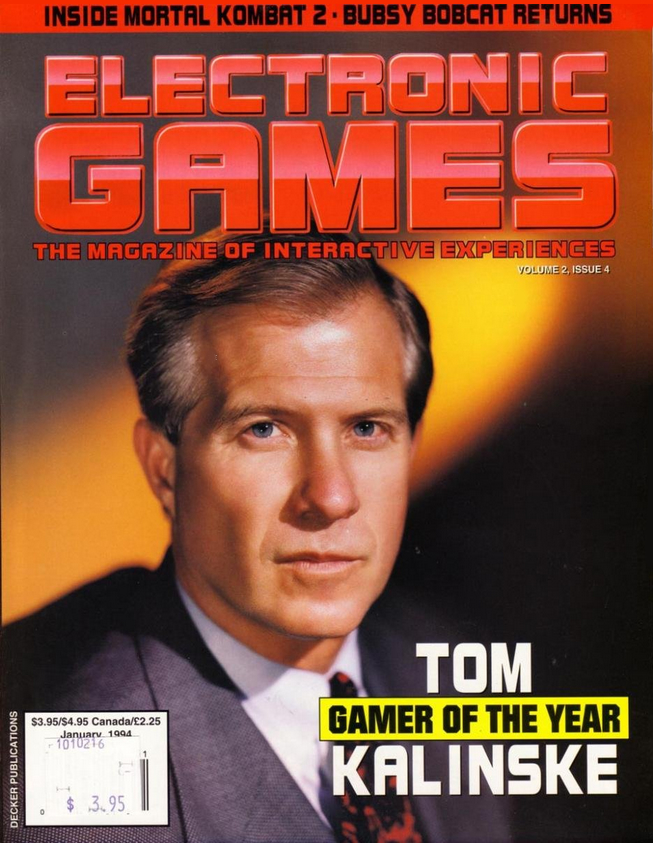
So, where does all of this leave Kalinske? His legacy is mixed, to be sure, but the evidence does give him a decent score overall (when one includes only the things he actually did and not those often misattributed to him). His efforts to make the Genesis the top console and break Nintendo’s monopoly bore true fruit, and while that success became too much to handle, it cannot be ignored.
After he stepped down as President of Sega of America on July 15, 1996, (he remained on the board of directors until September 30 of that year). He became the CEO of LeapFrog Enterprises Inc., a two year-old company with a single interactive product, whose total sales amounted to about $11 million a year. Under his leadership, the company went on to sell over 100 different titles and became America’s third largest toy company by 2003, raking in sales of $680 million dollars that year alone. He also became the president of Knowledge Universe, LeapFrog’s parent company, which works to offer online pre-MBA and MBA programs to working professionals through Cardean University. He then became LeapFrog’s Vice Chairman. Needless to say, Mr. Kalinske did quite well in his post-Sega days.
There has been much speculation as to exactly how much confidence Nakayama actually had in Tom Kalinske. When the Genesis was struggling in Japan but hugely successful in America, he seemed to be content with letting his American president have free reign. But as the industry turned and Sega experienced the failures of the Game Gear, Pico, and 32X; as well as the rising success of the Saturn in Japan (which never took off in America); Nakayama withdrew his support completely. If it is true that Japan never trusted Kalinske, then Sega’s failure in the late 1990s is the result of petty cultural differences and foolish pride. Japanese corporations have the custom of making examples out of executives who fail, eventually returning them to their former stature after they’ve been sufficiently humbled. Would this have applied to the American, Kalinske? Was his unofficial exile within Sega possibly an example of another Japanese corporate practice of reducing an employee’s responsibilities until they chose to leave? We may never know.
What we do know is that Kalinske’s departure was a lot more complicated than it was previously thought to be. It’s true that he brought massive to success to each of the companies he worked for, and he had a keen sense for finding the right way in business. That being said, there were a lot of issues regarding unsold Genesis inventory and taking too long to sunset the multiple hardware platforms Sega of America had to support. Sega was making mistakes across the board in the mid-1990s, from splitting its potential next-gen userbase with the 32X, rushing the Saturn to market in North America, spreading itself too thin to compete with Disney, and not accurately auditing its U.S. and European subsidiaries. We can likely say that allowing the most successful executive in its North American corporate history to leave wasn’t the main reason for its downfall, but it probably didn’t help.
Updated: 2/14/26
Sources
- Battelle, John & Johnstone, Bob. The Next Level: Sega’s Plans for World Domination. Wired Magazine. Dec. 1993.
- Dolan, Mike. “Behind the Screens: An Insider’s Oral History of the Video Game, from the Birth of the Brown Box to the Arrival of the Xbox.” Wired Magazine. May 2001.
- Harrison, John. “A Cloud Appears Over Sega of America’s Rapid Progress.” Mega Drive Shock. August 16, 2022.
- —. “Irimajiri Speaks Out about the Saturn, the 32X, and SOA’s Financial Troubles.” Mega Drive Shock. July 10, 2023.
- Kalsinke, Tom. Interview with Ken Horowitz. Sega-16. 11 July 2006.
- Katz, Michael. Interview with Ken Horowitz. Sega-16. 28 April 2006.
- Kent, Steven L. The Ultimate History of Video Games. Three Rivers Press. 2001.
- Perry, Douglass. “Features: The Rise And Fall Of The Dreamcast.” Gamasutra. October 27, 2014.
- Pettus, Sam. Genesis: A New Beginning. SegaBase. 15 May 2001.
- Yarwood, Jack. “Interview: Former Sega President Tom Kalinske on the Rise and Fall of a 16-Bit Empire.” Time Extension. December 27, 2022.
Pingback: Sega Saturn – Did You Know Gaming? Feat. Greg – UK Videos Overflow
Pingback: Como a SEGA conseguiu se afundar, Parte I | Fazendo Nerdice
Pingback: "Console Wars" now on shelves | TSSZ News