
As fans lost themselves in the wonderful world of Shining Force, Climax slowly began to expand its lore. It began the process of bringing the series to the Game Gear, an effort that would culminate with Shining Force Garden: Towards the Root of Evil (the subtitle according to Shining Force CD). That game introduced the brother of Climax co-founder Hiroyuki Takahashi, Shugo, to the franchise as its director. Armed with a small staff and a short production cycle, the younger Takahashi oversaw a side story that was set 20 years after the original game. The series stuck around on Sega’s portable for another sequel and also returned to the Mega Drive. By the end of 1993, there would be six Shining games available on Sega consoles, including one that oddly didn’t bear the name.
Indeed, Landstalker was the first Climax game to deviate in title as much as it did gameplay, a reflection of how it was completely different from its predecessors in almost every regard. Shining Force shed the first-person dungeon crawling of Shining in the Darkness for strategic battles with a huge cast, but the third 16-bit release from Climax stripped almost all RPG traits for a more action/platforming design and dropped players squarely in the role of a single hero. It also completely up-ended the gameplay perspective, broadening Climax’s intent to add different styles of play to each new game. The result was a game that was so different than any other before it that its creator deemed it a new franchise and not part of the Shining series, a decision that still sparks discussion today. Landstalker’s isometric, pseudo-3D world enchanted some gamers and infuriated others. Creating it was no simple feat, and developing the technology alone took longer than the game’s actual development.
Gaming Is Just Geometry
The surprise success of its debut project, Shining in the Darkness, caused Climax to rethink its business strategy. Hiroyuki Takahashi was already in talks with Sega about developing more RPGs, and those discussions bore fruit in June 1991 with the formation of Sonic Co., Ltd, a joint venture between Climax and Sega. The new affiliate would work to make the RPG development process easier by bringing in new talent from different industries that could apply specific knowledge of things like marketing, artwork, and game design to a particular project. The move was meant to expand Sega’s RPG portfolio on the Mega Drive and Game Gear.
It also gave Climax some breathing room to work on more projects. Thus far, the small studio was only able to focus on developing one game at a time, but with the expanded staff, it could tackle multiple projects. As work began on its next title, Shining Force, Takahashi and co-founder/programmer Kan Naitō decided to complete the vision they had of their Shining series taking the form of an RPG trilogy. Takahashi led the team on Shining Force while Naitō would be in charge of the group behind the final installment, tentatively called Hero Lancelot: Legend of Shining (Graphic Designer and Writer Yoshitaka Tamaki had at first suggested a name that sounded like an American TV series, such as Adventurer XX’s Great Adventure). Work didn’t begin right away, though. Naitō first had to figure out what kind of game would he make and how it would run.
It was March 1991. Shining Force was underway, and Naitō contemplated his options. He had always been obsessed with 3D, spending hours playing PC-6001 games like 3D Maze and Quest. To a degree, he had achieved his goal of making one of his own with his first Mega Drive game, Shining in the Darkness. It was a monumental evolution from his initial attempt at 3D in 1986, Midnight Brothers on the MSX computer; however, while Shining in the Darkness took place in what was supposed to be a 3D environment, player movement was restricted to claustrophobic corridors. The game felt 3D, as movement occurred in a simulated 3D environment. Players could move forward, backward, left and right; but Naitō felt he could do so much more than just hallways.
His vision was grand. He wanted players to be able to move vertically and even diagonally and have an increased sense of depth and one of height. How though, could he achieve that on the Mega Drive? At the beginning, he wasn’t even considering an RPG. He knew that 3D could be applied to all kinds of genres, and he loved cars, so why not make a racing title? Would that be the best application? He was unsure about how to take the next step.
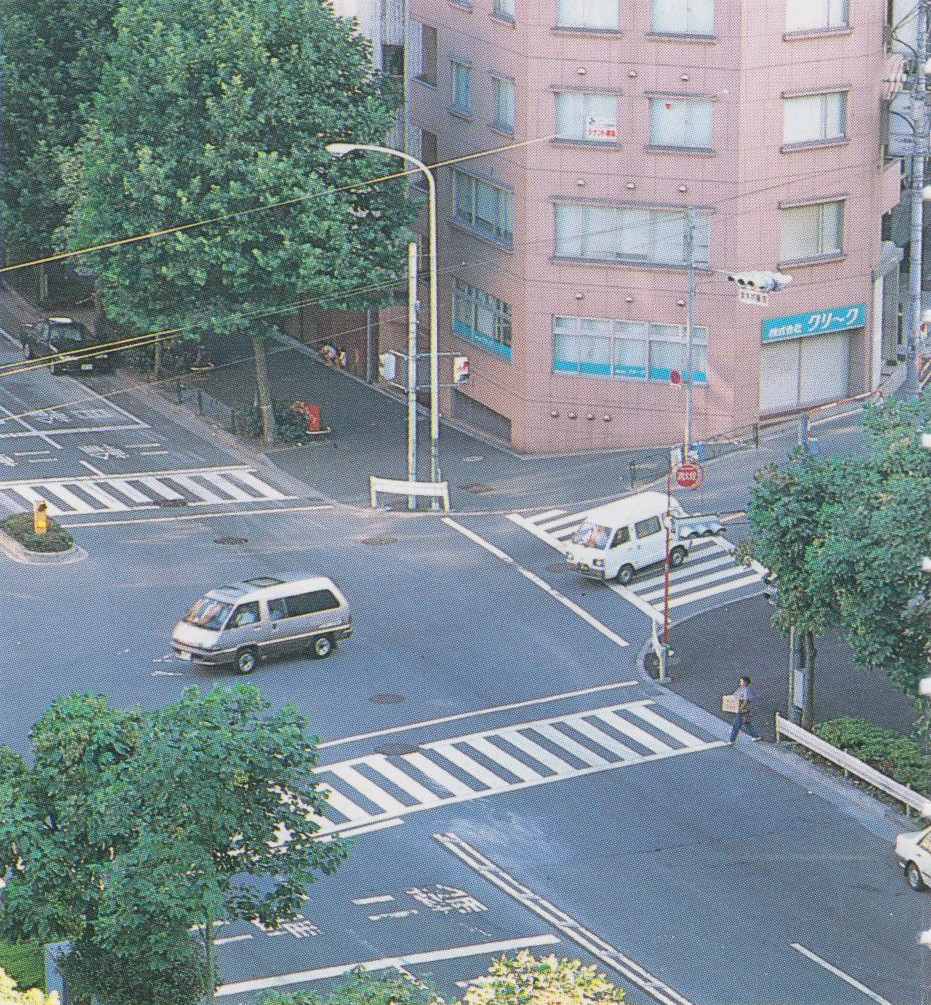
Then one morning, the idea came to him in the most unanticipated way – as most great ideas are want to do. As he gazed down from his 10th-floor apartment window, watching people crossing the street and traffic stopping, starting, and turning, it came to him. His diagonal perspective gave him a clear view of everything occurring outside. “While I was absentmindedly looking outside from the window of my apartment I thought, wouldn’t a game played from this kind of viewpoint be interesting?” he revealed in a 1992 interview. He thought of how viewing the game angle from such an angle could give the action a movie-like sense of immersion and realism, like in the Indiana Jones films he enjoyed so much. No such system existed at the time, and Naitō only had a vague idea of how one could implement an isometric perspective into a video game. He had no clear way to make it happen.
It occurred to him that perhaps he was thinking on too large a scale. He reflected back to his childhood and his love of model trains, radio-controlled cars, and miniature dioramas, particularly the house of Takara’s famous fashion doll, Licca-chan, created in 1967 by the shōjo manga artist Miyako Maki. As Japan’s answer to Mattel’s Barbie, Licca-chan also had a ton of accessories, including small doll house. Naturally, crafting such a location was impossible, as the crop of game consoles on the market at the time weren’t capable of full 3D. Naitō’s solution was to create a game that used an oblique angle as its perspective. In that way, it could simulate a 3D environment by expressing a sense of depth and height.
Unfortunately, there was one major obstacle before him. He wasn’t even sure if it could be done on the Mega Drive. Naitō did some research and found that there was no clear precedent for him to use. Games using this viewpoint were common on computers like the Amiga, but aside from a few exceptions, they were still quite rare on Japanese game consoles. Most titles that used it, such as Solstice (NES, 1990), were played on only a single screen due to the issues they caused with things like storing image data in VRAM (Video Random Access Memory). Game screens displays weren’t structured obliquely and were strictly based on vertical and horizontal alignments. Oblique representations were considered inefficient, and they took up too much data. Naitō would have to overcome these basic concepts and create his design in a way that took memory usage into consideration. It seemed unattainable to him at first. “I asked myself every morning, looking in the mirror (Steve Jobs style), ‘Am I perhaps attempting something eternally impossible?'” he expressed in a 2022 column for the website Beep21.
At the start, Naitō still didn’t even have a game concept. He wanted to create what he called an “electronic diorama world,” and he saw applications for it in a puzzle game, simulation, or even an action title. It didn’t matter, as long has players could move freely within its world. Making that vision a reality was something Naitō saw as a challenge, but he was determined to make it happen. It would be new and fresh, a type of world no one else had yet achieved on the Mega Drive. Eventually, the idea coalesced into an action/RPG, a genre in line with Climax’s previous Mega Drive releases.
Shine Bright Like a Diamond
Naitō’s intent was to create a game engine that could express three-dimensionality, one that could accurately reproduce height and depth using an isometric perspective. He began working on the programs to make his three-dimensional diorama a reality in February 1991. This crude, early version of the engine still didn’t have a name and could only express a single level of height. It used a series of diamond-shaped panels (the smallest unit composing the game floor’s surface) measuring 64×64 pixels, which were basically diagonally-placed squares. Each was quite big, making the area visible on a single screen very narrow, and every map was composed of a series of these panels. The interior of a house, for instance, could be a single map, while larger areas, like a dungeon and an overworld section, could have multiple maps connected by corridors. The maps came in all sizes, and not all of them filled the entire screen.
As Naitō labored on the engine, there were others on his newly-assembled sub-team who were also still working on Shining Force. Graphics Designers Hidehiro Yoshida and Tamaki were among those burning both ends of the creative candle. Creative Director and Chief Map Designer Kenji Orimo was also on both teams, and he recalled how at first, there wasn’t much for anyone to do while Naitō worked out his design. “Whereas Shining Force quickly had its system and scenario decided and the project got underway, Hero Lancelot was still a completely unknown game. Everything depended on Naitō’s skill. Every day, Naitō silently sat in front of his computer, never saying a word. He might occasionally yell something like, ‘The height is…’ or ‘The diagonal scrolling is…,’ but no one knew what he was doing.”
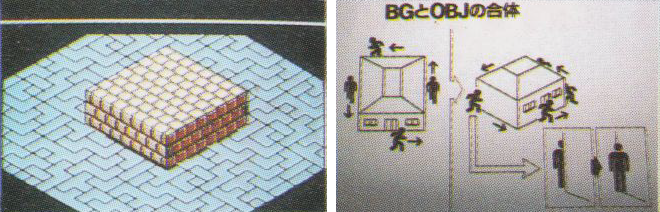
Orimo wasn’t wrong about Naitō’s frustration. The programmer was having all kinds of trouble figuring out how to make his isometric geometry work, starting with the basic aspect of control. A game played from this perspective would move diagonally in four directions, omitting standard vertical and horizontal-only movement. The Mega Drive controller worked well in this regard, so Naitō designed his movement program this way. It was fine, for the most part, but it could occasionally be problematic, he recalled. “It was programmed to determine the player’s intention based on previous movements, even if the user unintentionally input diagonally. However, this sometimes led to players feeling that movement was not smooth.” He felt such reactions were natural, considering that most players had never experienced diagonal control in a Mega Drive action game before. With enough time and practice, they would get used to it.
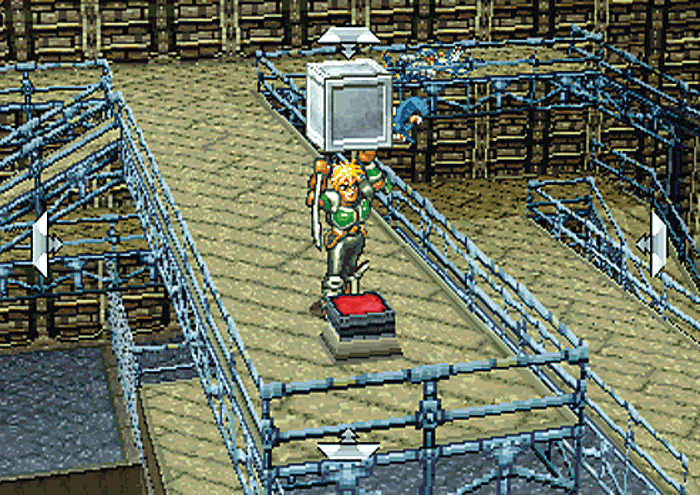
The most challenging part was getting the height to work. Moving within a flat space, like the hallways in Shining in the Darkness’s labyrinth, was no trouble, but movement within a diorama required verticality. The issue was that objects like trees and buildings would obscure players’ view, a factor that could prove crucial during combat or a specific instance of jumping to reach an item or new location. Particularly, Naitō had to battle to ensure consistency when character’s position within the same location, like a building, changed the priority order of objects (front or back). If he couldn’t get that element to work, then there was no point in having a pseudo-3D perspective. The Mega Drive struggled to perform the task, as it wasn’t something Sega had considered when it designed the console. Naitō persisted, taking things slowly, and he had to reprogram multiple times to gradually make the expression possible. He was using an image of Mickey Mouse (drawn by Yoshida) as a character placeholder to test the character movement. After about a month, he was able to get Mickey moving, and the floor in the background now scrolled diagonally in all four directions. At first, height consisted of only one or two steps, but he soon had it up to around 15, and the map panels were much smaller. It was this breakthrough that made his “electronic diorama” feasible.
Completing that first version of the system was a milestone, but it made some major problems quite apparent, and turning it into something that was actually playable was going to be difficult. Progress now came slowly. Each new version increased the levels of height and expanded the viewable area. Over time, Naitō refined the system and gave it more structure, squashing problems and bugs wherever they arose (and they did so often). He had to overcome several major issues, such as figuring out how to overlay the background and the characters. It was difficult to place multiple characters on top of three-dimensional objects in the background or to hide them behind walls. Every object in the game had thickness, forming a six-faced shape with top and bottom surfaces. Even the back walls of buildings, which are never seen in-game, existed as data in the engine. Because of this, characters – also represented in the data as virtual 3D objects made up of stacked diamond shapes – could move freely behind objects and buildings throughout the game world.
The engine’s processing speed also worked against him. Using three dimensions on the screen meant that the system used an enormous amount of data volume, reducing processing speed. It took a lot of time to make things scroll diagonally without slowing everything down to a crawl. As the game would be entirely isometric, the Mega Drive would have to perform these calculations constantly. For instance, opening a window or selecting an item wasn’t something the game had to process all the time, but moving the character and scrolling the entire screen were. That frequency could bog down everything else if it weren’t optimized. “Unless you make the processing as fast as possible and keep memory usage small, the effects will branch out from there and impact everything else. It becomes the biggest bottleneck in the entire program,” Naitō warned. He overcame the issue by developing formulas that represented the diamonds in vertical and horizontal directions as vectors (objects generated by looking at its attributes rather than storing the data for each pixel of an image).
The rest of the team saw only glimpses of this progress over several months. Naitō was meticulous and waited until he had a solid and robust version of the program running before he showed it to anyone. When he finally revealed what he had achieved, they were amazed. Naitō, however, wasn’t satisfied with all the issues that still needed resolving and set the team to work. By autumn 1991, Orimo and the other map designers were able to operate within the engine and speed the game’s development along so that Naitō and several others could step aside for a while and help the Shining Force team. Takahashi’s group was in a serious crunch, so Naitō joined on different occasions for around two months total to program the multiple towns players visited. Almost half the Hero Lancelot team were involved in that effort, and only when it was completed could they return to work on their own project full time.
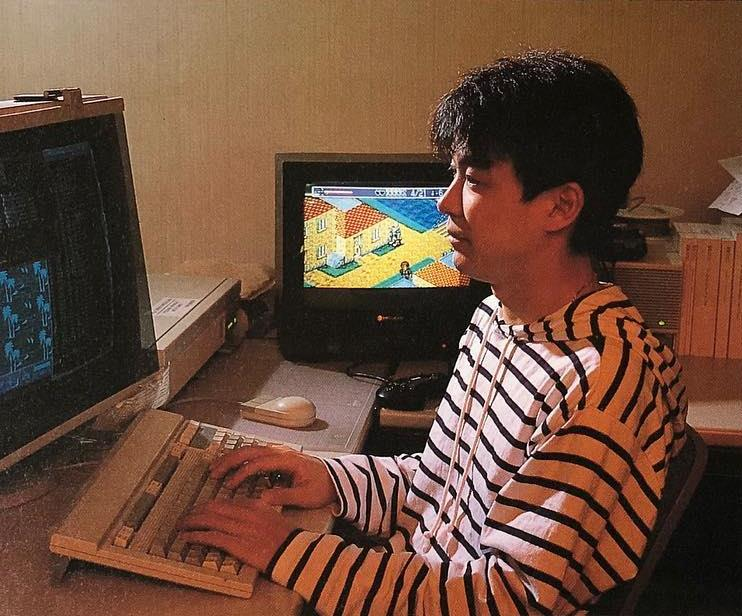
Even as the new system was being upgraded, new maps were still being drawn. It was an uncertain process, as the map designers didn’t really know what could be done until the newest version of the engine was presented. Often, upgrades in the engine presented new options for completed maps, and improvements to the amount of height that could be expressed made a lot of maps seem more puzzle-like than adventurous. The team had to correct these unexpected results, adding another task that took time and imagination away from creating fresh maps. Indeed, Naitō may have been optimistic that the project’s ever-expanding ROM size would be enough (it would eventually be 16Mb), but conceiving so many new and original areas was almost as hard as programming them. Map Designers Yasuo Hayashi, and Orimo had produced all the maps Naitō had anticipated for the 3D engine, yet as development wore on and the game became larger, it became harder to keep going.
According to Orimo, the key to reaching Naitō’s map goals was the arrival of Map Designer Yasuhiro Ōhori that autumn, a man many gamers know as the co-founder of Matrix Software, the creators of the PlayStation classic Alundra. He joined as external production staff as part of Sonic Co. Ltd.’s mandate to bring in extra help to lend expertise to Climax and Sega’s RPG development. Hired to to design the game’s maps and the traps they contained, Ōhori brought years of experience in game design to Climax, along with a lifelong love of video games. He started with them early in life. The Space Invader boom hit just as he was entering junior high school, and he spent his formative years pouring money into Galaxian and Pac-Man. He could see that video games were extremely popular all over Japan, and he wanted to do something that would reach players and bring them all together, a tough plan to execute in this time before the Internet and widespread gaming magazines. Ōhori took it upon himself to get the ball rolling, and his first attempt at doing anything industry-related was creating a Pac-Man fanzine for a classmate that included a strategy guide. After playing Xevious, he decided that he wanted to cover video games on a regular basis through fanzines. Only two weeks after Xevious debuted in Japanese arcades, Ōhori had cleared it, even sending in a six-hour-long gameplay video to Namco as proof. He asked the game’s creator, Masanobu Endo, if he could write about it, and, with Namco’s approval, he published a strategy guide called “How to Get 10 Million Points in Xevious” in the first issue of Satoshi Tajiri’s (of Pokémon fame) fanzine Game Freak. It sold 3,000 copies through mail order, and by age 16, Ōhori had started his own magazine, SuperSoft, which compiled high scores from all 47 Japanese prefectures – a sort of Japanese Twin Galaxies Scoreboard. Eventually, packing and mailing out the magazine each month became too much work for a single high school student, so Ōhori recruited Tajiri to help. Animated by gamers’ reception to his initiative, Ōhori then leveraged SuperSoft’s popularity into the creation of game hubs in each prefecture so gamers would have places to gather and meet. He was able to create 100 of these centers.
Ōhori also became interested in making games himself. His first published work, Mobile Suit Z Gundam: Hot Scramble (1986), shipped while he was still in college and introduced him to the world of digital map-making, but his next project initiated him in game design. The Famicom puzzle game Sanrio Carnival (1990), served not only as his design debut but also helped put his name on the map. Though it featured Sanrio’s popular Hello Kitty characters when it was released, the property wasn’t yet a thing yet when Scitron & Art Inc. started developing it. The company was interested in licensing but couldn’t get anywhere with Sanrio. As a Famicom publisher, it turned to Nintendo for help, and the game became a Hello Kitty vehicle to be published by Character Soft Co., Ltd., Sanrio’s software label. Ōhori benefited from the development advice Scitron & Art got from Nintendo’s Shigeru Miyamoto, who saw Sanrio Carnival’s progress before release. The game’s success helped Ōhori establish himself, and he became a full-time software developer doing debugging work and game planning. It was a path that led him directly to Climax.
Ōhori’s experience was welcomed, but it was his personality that made the most difference. Orimo and the other map designers were exhausted, having created hundreds of maps, and they were struggling to come up with fresh, innovative ideas. Ōhori helped reinvigorate the company atmosphere and brought a new perspective to the project, helping to shape it into a balanced blend of action and adventure that gave it a proper identity distinct from the two previous Shining games. Creating a good map wasn’t enough if it didn’t have the proper challenge to it. “Every night, he took Naitō and the graphics staff to the arcade,” Orimo recalled. “What he mainly showed them there was Capcom’s fantasy fighting games. In other words, he wanted them to study monster movements.” Ōhori’s “Arcade Game Research Group,” as Orimo called it, also looked at how other developers were implementing 3D gameplay elements into their games, anything that could help spur their imagination. These arcade visits were key to helping the team solve how combat could work diagonally, and maps that took advantage of 3D, like castles, waterfalls, and ravines, were soon drawn up.
Each designer handled a specific dungeon, and each room was created one by one, with ideas sketched onto homemade diamond grid paper that was full-sized and served as each dungeon’s blueprint. Figuring out movement and attacks on the diamond panels wasn’t easy, so Climax programmers used a simple yet effective tool in their field design and event planning – a piece of transparent plastic wrap with a small square of paper placed in its center. As unorthodox as it sounds, it was helpful for estimating where the main character would be onscreen and how he would move. The plastic wrap simulated the game area displayed on a television screen, and the small paper piece represented the main character’s position in that area. When the wrap was placed on top of the full-sized, diamond-grid map blueprint of that section of the game, say a dungeon level or a screen in the overworld, the team could then slide it around to simulate his movement accurately. It was definitely a low-tech solution, but it worked.

By winter 1991, Naitō’s 3D program was almost complete and could create as many as 520 maps. He called his new 3D spatial system the “Diamond-Shaped Dimension System 520 (DDS520),” a name he chose simply because he liked how it sounded and because he wanted people to recognize it as a completely new engine. Despite the “520” part of the DDS’s name, Naitō initially told the project’s map designers that their game would only encompass about 200 total maps. As development progressed and the team reached that goal, he told them that they would actually need to reach the 520 number. By mid-June 1992, and as the number approached 500, Naitō announced that an additional 1Mb of space would be allocated for maps, so about 200 more would be required. DDS map capacity soon eclipsed 600, then 700, until finally capping off at 850 total maps (the name remained the same to reflect the initial goal and because it was too problematic to keep changing it). Naitō estimated that if all the maps were connected together on a monitor, the final piece would be the size of the Tokyo Dome. He described the gameplay to the team as being similar to creating a miniature game within that dome and controlling it remotely from a far, higher location, like using a radio-controlled car.
After a year of painstaking research and work, along with more than a dozen version upgrades, the DDS520 was finalized early in 1992. Naitō contends that the engine was so efficient because of the Mega Drive’s fast calculation speed (blast processing?) and its ability to easily handle backgrounds and characters. Aside from its limited color palette, it was the ideal machine for an isometric, pseudo-3D game. He doesn’t believe the DDS520 could have run on an 8-bit console, like the NES or Master System, and that it wouldn’t have been as efficient on the SNES.
Once Naitō finalized the engine, he and the rest of the Climax programmers then worked on optimizing its internal processing speed. As the engine became more and more refined, so did its potential applications. Soon, Naitō wasn’t just thinking of Climax’s current product with his design; he was considering its use in future titles. So, he had to make it as versatile as possible. Platforming in a system that was too slow would lose tension, and making it too fast would prevent more casual players from being able to keep up. It was challenging to find a balance that would engage both experienced action gamers and newcomers alike. Mickey Mouse had worked out so well as a placeholder character, and since Climax was considering platforming titles among the genres that could benefit, the design team was even considering that the DDS engine could be used for a Sonic the Hedgehog game.
Over the years, some players argued that the design was unnecessarily hard due to the control and that they were frustrated with diagonal platforming. One complaint frequently leveled against Naitō’s isometric design was that there was no way to determine the character’s position when jumping. Some people argue that shadows would have helped, but Naitō found that they didn’t work. Spatial awareness was discussed within the team, and it was agreed that if the characters had shadows, their positional relationships would be clearer. They even made an early version of the game that incorporated them but removed them from the final revision because Naitō didn’t like the fact that other visual elements would have to be reduced to add them. In a large, flat space it wouldn’t have been a problem, but the three-dimensional nature of the diorama world made them an issue because it would have greatly slowed down gameplay. “To accurately grasp positions, not only the characters but also traps would need shadows,” he explained. “Moving platforms, being large, would further increase the number of required shadow images. Furthermore, if shadows were added to enemies and townspeople, the number would become enormous, naturally slowing down processing speed.” Also, navigating many of the game’s obstacles, like moving traps, wouldn’t have been easier with shadows because the shadow’s position would have fallen outside the screen, making the players’ position still unclear. Traps that drop players to a lower level were shown as dark pits, so shadows wouldn’t have been visible anyway. Shadows would also have affected how Hero Lancelot’s story played out. Adding them would have cut the number of height steps in half, shrinking the game world and the number of traps and enemies that could be displayed. Even in towns, where spatial awareness wasn’t as crucial, it would have reduced the number of townspeople displayed.
The Treasure Hunt Begins
While the programmers were plugging away at the DDS520 and bringing his diorama world within reach, the design group had to decide on exactly what kind of action/RPG game the engine would run. Planning sessions became a regular thing, and Naitō arrange for key team members on the programming, designing, and planning staff to get away from the office for a few days using the same “training camp” method he had experienced while developing the Dragon Quest games at Chunsoft. One might imagine that these camps were relaxing and laid back at some exotic resort, but nothing would be farther from the truth. The Yomiuri Land Hotel where they stayed had some amenities, but that wasn’t why they were there. To Naitō, the hotel’s most attractive feature was that its meeting rooms were available 24 hours a day. “It didn’t have the stylish atmosphere of a Tokyo Disneyland official hotel; it was truly a lodging facility with zero entertainment atmosphere, like a training center,” he clarified in a 2022 interview. The camps were a no-nonsense series of meetings that started immediately after the team arrived – they didn’t even go up to their rooms after checking in! The first order of business was a meeting before dinner, and then it was back to work until the wee hours of the morning, and the cycle repeated the next day. Basically, the only time members weren’t in a meeting during the two or three-day camp was when they were eating or sleeping.
Eventually, fatigue would set in and creativity and attention spans would drop. The group would then head over to the nearby Yomiuri Land amusement park (the largest in Tokyo) to unwind. Riding the roller-coasters while tired made several members sick and made subsequent meetings less productive, so they were banned. The cycle repeated throughout the training camp’s duration. Some rest was necessary, but nothing was meant to interfere with the tasks assigned to each group – programming, designing, and planning. No one would leave until all the content assigned for the camp was decided. Then, members would go home and work on refining them to present at the next camp.
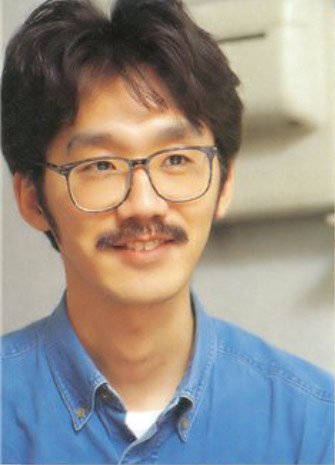
When Artist/Designer Yoshitaka Tamaki had enough input from the camp meetings to start designing the game’s protagonist in October 1991, Naitō and the others made two requests for him to consider: The hero had to be very appealing as a character, and he had to be a free-spirited adventurer who made decisions on a whim. Tamaki, who was responsible for the character and game world designs, now had to take everything the staff had discussed about the game’s style and perspective and put it all into drawings that could be expanded and built. After two years working consecutively on Shining games that were more serious in tone and that had worlds that were more rigidly designed, he wanted to do something different. Naitō agreed and asked him to come up with something that would fit an Indiana Jones kind of action or adventure game.
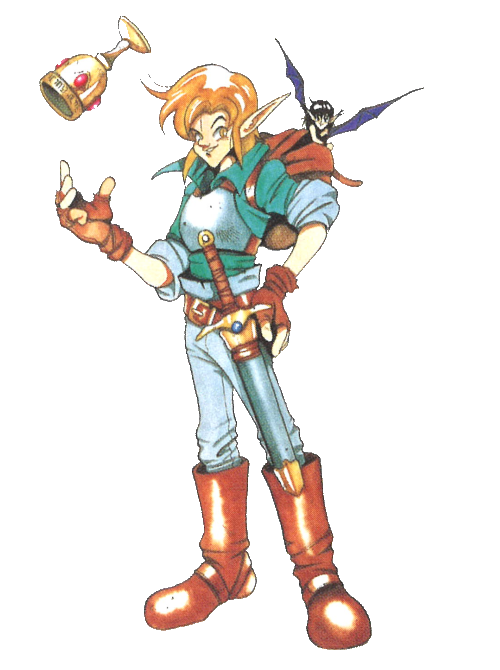
At the time, Tamaki was still finishing up on Shining Force and wasn’t involved in the initial design meetings about Hero Lancelot. Still, he had sufficient information to create a main character and a bit more. He opted to combine both action and adventure and returned a few days later with a sketch and description of a protagonist named Lyle (who will henceforth be referred to by his U.S. name, Nigel). Nigel wasn’t Tamaki’s first design for the hero. He had sketched a beastman wizard with a staff, a sort of “cat Gandalf,” but decided against it since it didn’t fit the Indiana Jones template Naitō wanted. Nigel was much closer to the mark. He was a forest elf that hailed from a small village in the continent’s inland region of Maple and been separated from his family when he was young. He was raised by an elderly couple and now sought to make a name for himself as a professional treasure hunter. Nigel was not the heroic archetype; he was an adventurer who lived according to his own code and preferred to rely on his own wit and fighting skills than work with others. Still, Tamaki didn’t want Nigel to just wander the land, aimlessly plundering whatever he saw. The character wasn’t completely amoral – Tamaki described him as a romantic who loved flowers and small animals – but he needed purpose, so he created rivals to compete with Nigel, much like Indiana Jones had his rival, Dr. René Belloq in Raiders of the Lost Ark. His early form remained consistent throughout development; save for the two swords, one long and one short, that he brandished in the early concept drawings. Those would be swapped for a single sword by the end of the project.
They were even more excited at the fact that Tamaki, with input from Naitō, had included a tiny fairy partner named Friday who journeyed with him. Of the pair, Friday was much harder to conceive. When first shown to the team, she didn’t even have a name. She was palm-sized and had no function. The design team liked the idea that she could perhaps heal Lyle, so Tamaki made her curing functional. The main healing item in the game, a plant called Eke Eke, was toxic to Nigel if he ingested it directly. Players would still have a reason to collect the item because Friday needed it as a physical component to cast a healing spell to revive him. Nigel could be revived so long as he had Eke Eke in his inventory.
Tamaki figured that the game’s scale would be better suited to having Nigel and Friday search for treasure in some long-abandoned location, like the fabled El Dorado or a lost continent, than in some cave or random dungeon. He even considered the possibility of Nigel looking for something more than just gold, and he floated options that included searching for a lost love, a mystical animal, or even making Nigel a bounty hunter. All kinds of ideas were battered around during conversations about what kind of quest and scenario Nigel and Friday would undertake. The team even played western PC titles to see if anything inspired them, but they found that none were compatible with the experience they were crafting with the DDS.
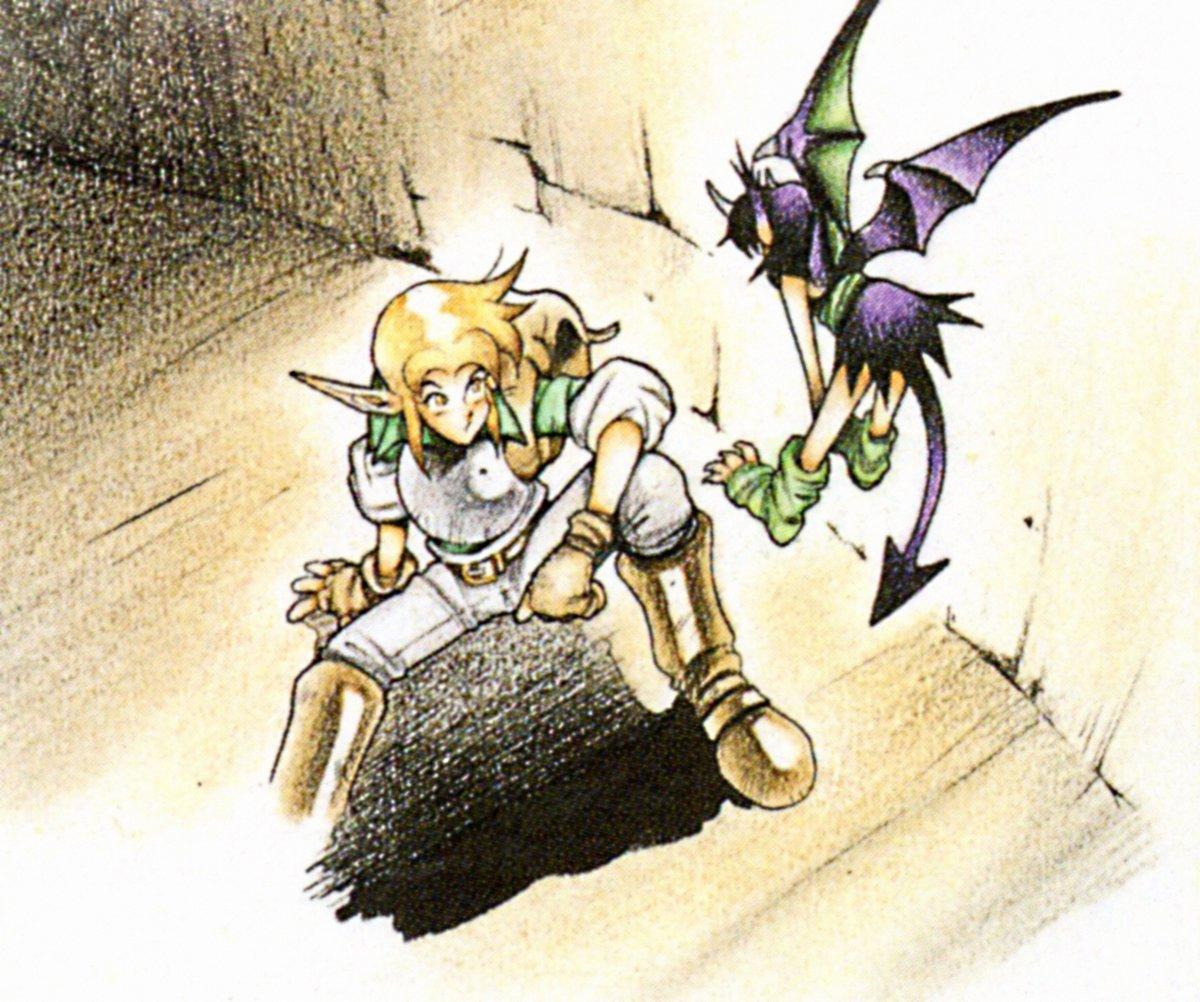
What they did discover was that their prospect of an elf hero who was healed by a small, winged girl seemed too similar to Nintendo’s The Legend of Zelda. It was suggested that Tamaki change the hero to another race, but he was adamant. “If you want a nimble, magic-using, free-spirited adventurer, there’s nothing more fitting than an elf,” he countered. Besides, his hero was a treasure hunter, not some princess-saving do-gooder. Hero Lancelot was fundamentally a different type of game. The team agreed, and Tamaki’s concept was approved without any major changes. The most notable alteration was that Friday would become a nymph to further separate Climax’s game from Nintendo’s series. Her backstory made her one of the few remaining nymphs in the world. Friday was born on Mercator island, the main setting of the game, and her tribe was enslaved by King Nole and forced to build the underground palace where he would hide his treasure. When the palace was finished, Nole’s henchmen burned down her village and killed all the workers to maintain secrecy, including Friday’s family. She managed to escape with an old nymph who was looking after her, and when she died, Friday became the last of her tribe.
Tamaki added several memorable characters that made the world of Hero Lancelot lively and fun. There was the Duke of Mercator, an ambitious ruler with a hidden agenda, and Mir the Magician, the enigmatic occupant of Mir Tower. Tamaki also crafted a rival for Nigel, the human female mercenary Kayla. Tamaki had intended for her to be like the heroine Fujiko Mine from the classic anime Lupin III, who was voluptuous and sexy. After drawing her two companions, Ink and Wally, she turned out much different. “When I drew two companions as a joke, she ended up looking like Marjo from Time Bokan [anime],” Tamaki laughingly recalled. Majo was a villain who considered herself brilliant and beautiful, but all she ever did was boss her companions around, a fitting role model for Kayla.
One character who didn’t fit a traditional characterization was Princess Lara de Wissica (named Loria in the Japanese version), who hailed from Nigel’s homeland of Maple. She wasn’t added until late in the design process and only appeared sparingly during the game, but she played an important role in furthering the plot. Tamaki didn’t want her to be a typical damsel in distress and gave her a naive and childish personality.
This workflow was the engine that pushed Hero Lancelot throughout its design process. Characters were created, then placed into an action setting, before the graphic work of designing the actual stages was done. Tamaki, despite the immense influence he had on Hero Lancelot’s creation, didn’t think he contributed that much and gave most of the credit to his colleagues. “Regarding characters, the staff came up with ideas, I compiled them into drawings, and then everyone looked at them and thought of various settings, and then I worked on those again. Many things were decided in that fashion,” he humbly said.
Creating a Grand Adventure
The complexity of animating Tamaki’s wonderful designs into the DDS520 took form in several steps. First, the story had to be broken down by scenario, or what was to occur at different points during the game. Whatever interesting ideas came up in meetings quickly found their way into a scenario. As those concepts took form, they were written into a special event sheet that organized them by quest and linked them all together. All characters and actions occurring during each event were detailed here, and the story details would sometimes be altered to fit a particular character’s personality. The writers could even detail which options players would have in each event or what battles might take place. Tamaki, Orimo, and Kouhei Nomura handled the plot, while the scenarios were written by Shinya Nishigaki.
If you’re a Dreamcast fan, you should recognize that last name. Nishigaki was behind some of that console’s weirdest cult-favorite titles, Blue Stinger and Illbleed – not necessarily the kind of games one would expect from someone with an economics degree from Aoyama Gakuin University, but Nishigaki didn’t likely intend to make games in the first place. His first industry job was as a promotional consultant for the Daiko Advertising Agency Enix (now Asatsu-DK). He had several clients within the game industry, working in its business development department and later on the English localization of Dragon Quest II and III. When Takahashi and Naitō left to form Climax, he joined them, jumping at the chance to do some game design of his own. Nishigaki handled the promotional work for Shining Force before later assuming the scenario writing duties for Hero Lancelot.
Nishigaki undoubtedly inserted some of his own love of film into his writing. His father was an advertising executive at Toho Studios, the company behind Godzilla, giving the young Shinya access to plenty of films with which to develop his budding imagination. As a student, Nishigaki had a part-time job on a TV sci-fi show and helped plan one of them. He now had a lot of experience and pent-up creativity to add to Hero Lancelot.
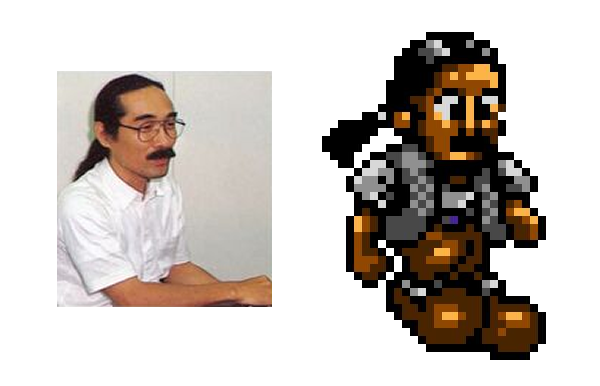
He wasn’t the only one to add a personal touch, either. Orimo, who had already made his video game debut as the model for Yogurt’s character in Shining Force, would appear in Hero Lancelot as Pockets, the friendly treasure hunter. The character was a dead-ringer for Orimo, ponytail and all. Not much of a rival for Nigel, Pockets would often get to locations first but never figure out how to reach the treasures he sought. Nigel would usually find him somewhere in a dungeon, thinking about how close he came or too afraid to proceed.
The scenarios didn’t always make it into the game as drawn up during meetings. Often, a new map would inspire Nishigaki to make changes that would add more realism and life to the world. For instance. Princess Lara wasn’t even originally in the game. She was included because the map designer who created the castle added a tall tower with a small room at the top. Everyone thought that a room that high should have someone locked inside, and if so, it should be a princess. Similarly, The gardener in the castle was added after the fact. “There was also a beautifully designed courtyard created in the castle,” Nishigaki revealed. “With a garden that well maintained, it would be strange not to have a gardener. And if there’s a gardener, there should be a room for them too. So, the game world kept expanding in a more and more realistic direction.” It was an atypical way to design a video game, but it worked. Orimo humorously called it the “flexible scenario method.”
The main quest began to come together in Autumn 1991, around the time that Naitō was making strides with the DDS engine, which was completed in early spring of the next year. Tamaki’s characters were thrust into an adventure where Nigel first encounters Friday, who was on the run from three bumbling criminals, Kayla, Wally, and Ink, who were pursuing her for her knowledge of the legendary hidden treasure of King Nole. During his conquest of the mainland territories long ago, Nole accumulated a vast horde of immense wealth, but its location was lost to time. Friday insisted she knew where the fortune was hidden, and with that promise, she persuaded Nigel to part with nearly all his savings for a trip to a far-off island. But once they arrived, she sheepishly revealed that she only has a hunch about its location. Not one to back down easily, Nigel decided to press on with Friday at his side, hoping that this daring escapade would lead him to unimaginable riches. Along the way, he had to traverse multiple dungeons and locations, battle enemies and avoid traps, and meet several interesting characters like the Duke of Mercator and Princess Lara.
Each dungeon or encounter took the form of an event, and Climax would include nearly 150 of them, big and small, by the time development was finished. Once the team knew what would happen in each one, a map of the area (dungeon, town, etc.) was drawn on the blueprint diamond grid paper. The team then brainstormed ideas of what kind of scenario would occur there. Sometimes, Ōhori and Naitō would act out the attacks Tamaki had given his monsters, gestures and movements and all. It looked bizarre, but it gave some life to art and a sense of how the creatures would actually move. Then, height data for the area, based on the art, was entered into the DDS and reproduced as three-dimensional objects. During this step, the maps were also connected together to form a field of 3D structures. To simplify working with 3D data, each area’s visuals were then displayed as a wireframe so that their full view could be displayed using Climax’s proprietary graphics tool, Mirage III, which was created by Climax 3D Graphic Tool Programmer Yasuhiro Kumagi and earned its name because it never seemed to be finalized. The software permitted Climax’s planners and designers to manage the map structure, layout, and character movements. It could also automatically detect any inconsistencies that deviated from the DDS specifications, which was a godsend when making sure that everything was compatible and mapped properly. The earliest version of Mirage was so complex that only Kumagi could use it, but by the third version, things were simplified enough so that even team members without knowledge of the DDS engine could understand it with relative ease. Once displayed in Mirage III, the visuals were then drawn based on Tamaki’s artwork as specified in his paper drawings.

Tamaki established the movements to Hero Lancelot through his artwork, making them relatively simpler to animate than Nigel. Most of them had only a few different frames to their attack patterns, but they still had to be animated from four different directions. Nigel was a much different story. Animating him put to test all of Graphic Designer Ryushiro Miyazaki’s experience in the anime industry. The 28-year-old had to use trial-and-error to get the elf’s movements right because unlike the game’s monsters, his actions weren’t defined in Tamaki’s drawings. Miyazaki had to determine basic movements like how Nigel would walk and what his sword swing would look like. Even standing still, the elf hero had four different animations (one for each direction he could face), compared to a standard side-scrolling game where the character would only have had to be drawn from the left and right. Then, Miyazaki had to do each animation for all movements in each of the four directions. Multiple frames were required for each one so that the onscreen movement would be smooth and natural, like a cartoon. For instance, Nigel’s numerous movements, like walking, jumping, and attacking each used four different frames. Then there were his other movements to consider, such as when he climbed a rope or picked up a pot or tablet. Some actions used as many as seven frames. The result was a huge number of animation frames that had to be done in the Mirage III program. At least Friday was much easier to animate because she only appeared during specific story events or when Nigel was knocked unconscious.
The next step was to place all the characters within the map to complete the scenario. After Yoshida checked them, the digitized versions of each map were finally sent to Naitō via LAN. He had to check them to make sure that nothing done in the graphics tool broke the geometry in DDS. “I was the only one who fully understood it, and there wasn’t enough time to bring everyone up to speed on DDS. So, it wasn’t possible to isolate only a part of the program for others to handle separately,” he explained. Of course, Naitō didn’t do everything involving the programming. That sub-group consisted of a half-dozen other people, including Tagawa, who handled things like the character’s actions and the movement of obstacles, such as the spiked iron balls found within several dungeons.
Sometime during this period of development, Climax changed the game’s title to Shining Spirit, a reference to a book found in a house in Shining Force. That name didn’t last long, serving only to tentatively identify the project in the information Climax and Sega began to release to the media for coverage. It wouldn’t take long for the game’s true identity to surface, and from then on, Climax only had to worry about making history.
From Mercator to Worldwide Fame
With the game taking shape, it was now possible to set a release date, which Climax estimated to be sometime in late October 1992. The studio typically worked backwards from a release date to decide when to announce a product via press conference, which meant new pressures and more crunch time. “Preparing for them was quite a task,” Naitō described. “It often led to delays in the main production, which was counterproductive. We had to take screen shots for media articles, decide the scope of public release, have staff interviews, and check proofs for articles. We also had to check strategy guides to be released alongside the game.” These concerns added to the already growing pile of tasks that needed to be resolved in time for the press conference.
One major task was debugging. Climax had around a half-dozen people involved, and they were constantly finding bugs and submitting video evidence to the programmers, much like any other software project. As much work as it was, it fostered a sense of camaraderie among the staff, who treated it like an “in-house training camp.” Anyone who made a programming mistake that caused a bug was “punished” by having to buy dinner at the local yakinuku (Japanese barbecue) restaurant that the staff frequented.
When Naitō unveiled Climax’s newest RPG to the press on June 11, 1992 in the Golden Cup reception room of the Tokyo Prince Hotel, he presented it as Landstalker, the final name that Climax had decided that spring. The change reflected the fact that the game was no longer part of the Shining series. According to the fan-made Heart of Diamond book, in which Tamaki participated, the title means “one who roams the earth” and refers to Nigel’s adventures as a treasure hunter. I wonder if some explanation was required at the press conference so that the press wouldn’t wonder if Nigel simply sneaked around and followed women.
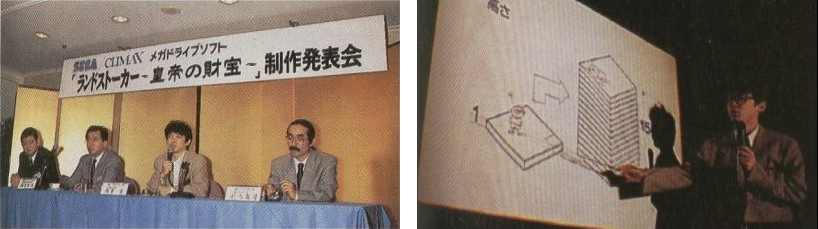
Naitō explained that since Landstalker was so different from Climax’s previous efforts, it should be considered an entirely new franchise. During his 30-minute presentation, he emphasized how Landstalker’s isometric gameplay used the new DDS520 system, showing the gathered press video and slides of how it looked in action. Though it was only around 50 percent complete, he was confident that it would be ready for its October release. All of the major engine and character design was complete, and the team was now in the process of creating the different maps and obstacles players would face. Even as Naitō presented the DDS520 to the press and explained the “520 maps” part of its name, his map designers had already made 600 of them.
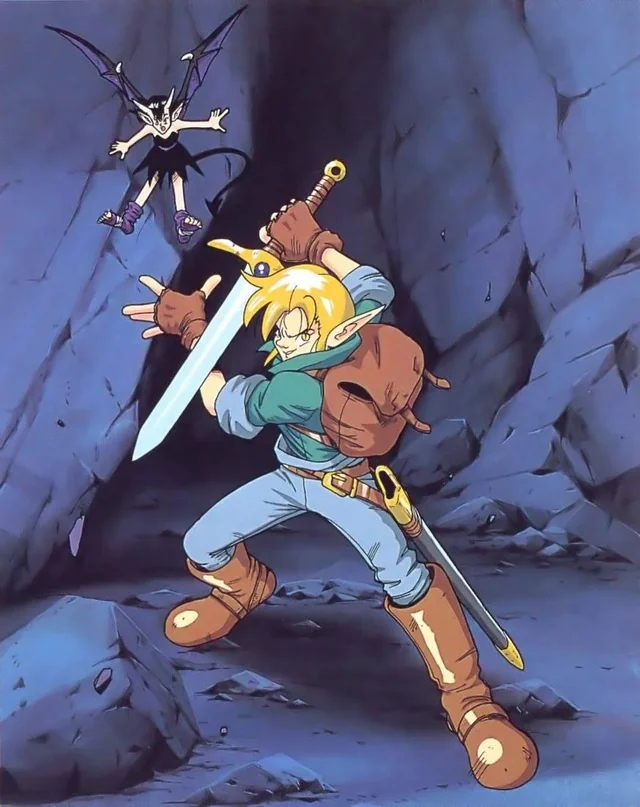
Tamaki created several iconic pieces of promotional art that were character-focused but enough for viewers to understand the game world clearly. Some scenes were directly from in-game scenarios, while others were made up for promotional purposes. These pieces have come to define Landstalker and are some of the most recognizable images related to the game.
A Treasure of a Soundtrack
As Masahiko Yoshimura was occupied with composing the soundtrack for Shining Force, Motoaki Takenouchi assumed that role for Landstalker. Young, talented, and eager, Takenouchi had only been making music for video games for about a year when he joined Climax, but he had been a musician his entire life. He learned to play piano as a child and was capturing his own compositions with a synthesizer by junior high school. While studying music at the Tokyo University of the Arts, where he was classmates with Hayato Matsuo (Master of Monster, Front Mission 3), Takenouchi did piano arrangements as a part-time job. A fugue he wrote for Dragon Quest earned him the attention of that series legendary compose, Koichi Sugiyama, who became his mentor and introduced him to the world of video game music.
Under Sugiyama’s supervision, Takenouchi did some recording for Star Command (1988) and later arranged themes for E.V.O.: The Search for Eden (1992). Landstalker was only his third video game score after graduation and his second Mega Drive project overall, the first being 1991’s Jewel Master, an opportunity that also came thanks to Sugiyama. That game, which started as a Sharp X68000 title, was eventually released on the Mega Drive, and the development team was so pleased with Takenouchi’s work that he was invited to score its next project, the 1992 RPG Double Moon Densetsu for the Famicom.
After Jewel Master, Takenouchi found himself at Climax, most likely through Sonic Co. Ltd. The in-game screen shots he was show in February 1992 were still quite early, but it was clear how different it was from any other game he’d seen before. Climax used a simple process for creating game music. Takenouchi was given a “music order form” that detailed such information as the total number of songs, their length, and in which scenes they would be used. Once he saw Landstalker in motion in April, he began to compose the first tracks, the town and field themes. The footage he was shown didn’t have any enemies, so he wrote the field theme in a more laid-back manner, as though Nigel was taking a stroll. It was rejected and took him several revisions to get it passed.
The number of total maps in Landstalker kept increasing, to the music order kept getting larger, capping off at 40 tracks. Takenouchi had been unsatisfied with how his Jewel Master score sounded. He wanted to make Landstalker’s soundtrack special, despite his lack of experience with the Mega Drive sound chip still causing him problems like not being able to manage extra noise at low volumes. “I still regretted not having been able to check the music playback on the Mega Drive during the development of Jewel Master, but for Landstalker, the development environment was in far better order, so I was able to adjust the music to the smallest level of detail,” he told the website VGMonline.
For Landstalker, Takenouchi mixed orchestral and rhythmic elements to give it a distinct sound. This unusual combination made the soundtrack avoid any single characterization, and some tracks seemed like they didn’t even fit – a deliberate move by Takenouchi. Take “A Ballad for Princess Loria,” for example. Composed by an in-game character named Ludwig, it is a love song, completely out of character for the spoiled princess. The song is meant as an expression of Ludwig’s love to her, and Takenouchi went the extra mile to give it the emphasis it deserved. “Normally, game music is created by inputting data from a finished score,” he detailed. “However, for the princess’s theme, I tried to reproduce what I actually played on the piano without considering data compression. This song plays for nearly two minutes during an in-game event, so I hope people listen to it carefully.” There are no required controller inputs while it plays; players are supposed to simply put down the controller and enjoy the music. Takenouchi’s tendency to get carried away was also evident in the underground labyrinth theme used late in the game. It was only meant to be half a minute, but he liked it so much that he extended it to around 90 seconds.
Takenouchi would remain at Climax for some time, composing the music for Shining Force sequels on four different Sega consoles: Shining Force Gaiden, Shining Force II, Shining Force CD, and Shining Force III. He would leave the game industry in 1996 after becoming unsatisfied with how his music was tied to the quality of the game it was made for. He was blunt in his justification for why that was unfair to not let his work stand on its own merit. “I couldn’t be satisfied with a corporate system that allowed unfinished products like Shining Wisdom to be put onto the market.” Takenouchi wanted to be considered part of the music industry rather than be merely associated with video games, so he left to do some direction work and later started an indie band called Autumn-River Willow.
A Quest by Any Other Name?
Takenouchi’s arrival at Climax is where something of a puzzle regarding Landstalker’s name begins. “My involvement with the project began with talks about a game called Shining Rogue. There were internal frictions at the development company, and in the end the game didn’t end up as part of the Shining series,” he revealed in an interview for VGMonline and adding a bit more spice to his earlier criticism of Shining Wisdom. Was Takenouchi hinting at some underlying animosity within Climax? No one knows. What is known is that Landstalker was, at first, meant to be a proper Shining game. It remains unclear if the name was truly Shining Rogue, and if so, why it was changed. The Making of Landstalker book never mentions that title, and the game is only ever referred by its two working titles Hero Lancelot and Shining Spirit. It is known through primary and contemporaneous sources that the GAU Entertainment action/RPG Crusader of Centy, was originally titled Shining Rogue, but the only evidence for Landstalker was a December 8, 2001 footnote on Climax’s site by Yasuhiro Taguchi, which stated: “When I first met Yasuhiro Ōhori, CEO of Matrix Software, I was making the first Shining Force and Shining Rogue (later Landstalker), and Mr. Ōhori joined the project as external production staff.” Taguchi was credited in Landstalker as the Sound Effects Programmer under the alias “Dōgen Shibuya,” a callback to his days working as a sound programmer at Cube Software, where he had created the sound driver (possibly called “Moonlight 99”) that would later be used by Climax for its Mega Drive games. Taguchi was credited under his full name by Takenouchi in the arranged album of Landstalker’s soundtrack under “Special Thanks.” We know that several Climax staff were involved with both projects. Could they have been left uncredited or included under aliases as well?
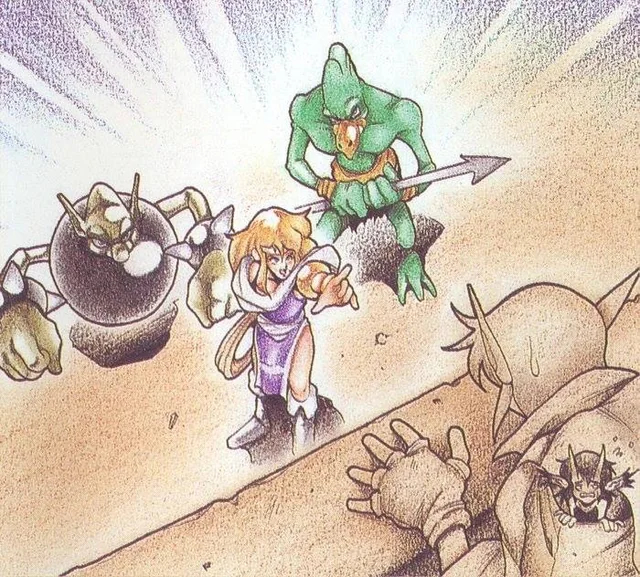
It’s clear from Landstalker’s design document that Tamaki had intended for the game to be part of the Shining world. Landstalker was set immediately after the events of Shining in the Darkness and had several close ties to it. For instance, Nigel was a forest elf, the same species as Pyra, and the game’s main setting, Mercator Island, was originally called Melville Island and was located to the south of the Kingdom of Thornwood. Two of Landstalker’s main antagonists, Wally and Ink, also had ties to Shining in the Darkness. Tamaki’s concept art identified Ink as one of the Chestbeak creatures from that game. Players were introduced to them the first time they encountered a trapped treasure chest and a chestbeak popped out once it was opened and hopped on top of it to fight. Wally was a member of kromeball species, a bouncing orb that rushed down corridors to attack. Tamaki obviously had clear intentions to open up more of the world established in Shining in the Darkness, which never let players explore beyond the labyrinth.
All these ties would be removed by the time Naitō unveiled the game at Sega’s press conference. Why? That is the burning question. The official story is that Naitō’s game was so different, it didn’t fit the Shining mold anymore; however, Takenouchi’s comments imply that there was some level of conflict within Climax, perhaps causing a break between the two co-founders and leading to them work on their concurrent projects as two separate camps. That could be why Taguchi received no credit for Landstalker, as he did most of his work with Takahashi on Shining Force. Even Naitō himself refused to shed light on the subject, answering with an ambiguous “Maybe…” when directly asked by Retro Gamer and Time Extension contributor Ashley Day about it.
Adding to the confusion was answer by former Wolf Team and GAU Ent. programmer Yukihiko Tani for a Time Extension article on the making of Crusader of Centy. Tani contended the following: “Ragnacenty [the Japanese title for Crusader of Centy] was initially supervised by Hiroyuki Takahashi, currently CEO of Camelot, who was in charge of the Shining Force series. Since Mr. Takahashi was also involved with Landstalker, Shining Rogue was used as a prototype name.” That sounds like a plausible explanation until one gives it a bit of thought. First, Tani did not work at Climax and didn’t seem to know that Shining Force and Landstalker were made by different teams or that it was Naitō who headed Landstalker’s creation. It’s possible that Takahashi had some uncredited involvement with its development, but Naitō, by his own admission, did very little programming work for Shining Force but was still credited as “Okochama” Naitoh while Takahashi was not (one wonders then, what Taguchi did).
One plausible explanation was that the Shining Rogue title was adopted at the game’s earliest stage of creation, when things were still at the simple concept stage and before Naitō started working on the DDS. This is when Takahashi was most likely to be directly involved. Once Naitō had his team and proper design efforts began, the title was likely scrapped for Hero Lancelot due to how far the DDS had evolved from the original conception. All this, of course, is speculation. It’s the best we have, however, until Naitō or Takahashi confirm exactly what happened. If that Takenouchi said about internal friction is true, then we may never know.
Nearing the End of the Quest
Climax had moved to a larger building in September 1991, and by the time Landstalker neared release, several members had already relocated to be closer to the studio. Naitō joined them, renting an apartment a few minutes’ walk from the office. It was his first time living alone, and while it meant he could no longer ride his NSX motorcycle to work every day, he loved the view of Tokyo Tower and all the high-rise buildings from his window. Even so, he typically didn’t even go home to sleep despite having a new waterbed to ease his chronically sore back. Naitō would often sleep behind some cardboard on the floor of his cubicle, a practice he would continue for years. He wasn’t alone. Ōhori also spent more time at the office, moving his clothes there for an entire week so he could work as long as possible. He vowed not to shave until the game was completed, and his beard’s slowly creeping length became the subject of office humor over the course of remaining months of Landstalker’s development.
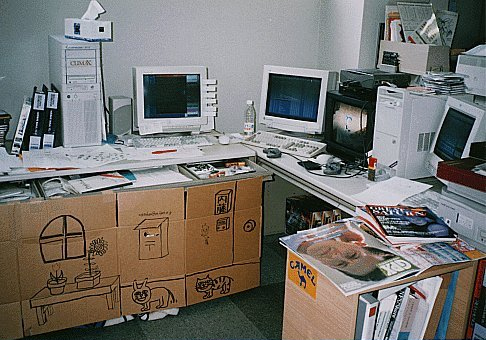
Naitō and the programming team were regularly tweaking the DDS520, and the Mirage development tools were constantly being upgraded and improved, but about two months before release, the workload was starting to take its toll. Ōhori and the other map designers were mentally spent and couldn’t think of anything else to add. When the game was about 80 percent complete, and the number map designs had ballooned to around 700, they decided to ask for ideas from the rest of Climax and posted a notice in the company office. Applicants had one week to submit their map ideas since it seemed unlikely that anyone would submit something if they extended it any longer than that. The best idea came from Graphic Artist Ryushiro Miyazaki, who had a deep knowledge of the DDS520 system and proposed a map called the “Greenmaze.” Map Assistant Hiroto Nakashima submitted maps called “Trent Tree” and “King Nole’s Palace.” All the different submissions helped push Landstalker’s map total past 680, well above Naitō’s original goal. Some even became major sections of the game, like Miyazaki’s Greenmaze and Nakashima’s Trent Tree (as the Tibor Tree).
The final months of Landstalker’s design were a flurry of crunch-related additions and revisions. The summer of 1992 was perhaps the most hectic of times for Climax, as Naitō tweaked and upgraded the DDS until it was at its twelfth and final revision, the staff rushed to finish each character’s action patterns, and Takenouchi finished the audio. The range of tasks undertaken were all over the spectrum, from new sub-quests and dungeons bring added to the selection of the game’s title design. Everything was deliberated as a group (the title design alone went through more than 20 pattern choices before it was finalized). Revisions kept coming until Landstalker’s ROM was finalized that September.
X Marks the Spot
After almost two years of exhaustive work, Landstalker finally hit Japanese store shelves on October 30, 1992. Reportedly, it was a solid seller, moving around 35,000 units during its first week alone. The gaming press loved it, and Sega was planning for a worldwide release. Naitō’s 20-month gamble had paid off. Climax had another hit, and it had shown that there was plenty of room for new types of RPGs on the Mega Drive.
The team celebrated Landstalker’s debut by taking some time off, heading to the famous Atagawa resort for its open-air baths and putt-putt golf. It was a short respite from the hectic schedule that had been the norm for over a year. Landstalker may have finally shipped, but Climax was still finalizing the two Shining Force sequels for the Game Gear and was already deep into development of its next Mega Drive project, Shining Force II. A victory lap, however short, had to be taken to keep spirits up.
Things were going well for the company, but Naitō had been somewhat nervous about whether Landstalker’s sales momentum would have any legs to it and if the public would truly accept something so different. It might seem odd that he would still be apprehensive about the game’s chances, considering how well Landstalker’s launch had gone and because Climax already had two other successful Mega Drive titles under its belt. With all the activity going on at the studio, however, there was little time to really enjoy the fruits of his labor. Naitō instead looked to the small moments when he could tangibly see how much RPG fans loved Landstalker. He made sure to be present on release day, and he happily watched as it went on sale at the local Yodobashi Camera store in Shinjuku, just a short distance from the Climax office.
Landstalker would take almost another year to leave Japan, and although it was successful, things within Climax were about to change considerably. The company was now on two different tracks, one led by Takahashi and working on the Shining Force line of titles, and the other under Naitō. For a while, Takahashi would remain as head of Climax and Sonic Co. Ltd. (renamed Sonic! Software Planning) before turning Climax over to Naitō completely. Sonic! Software Planning would continue its string of excellent Shining games well into the Saturn era, and in 1994, Takahashi would start another software house, Camelot Software Planning, helmed by his brother Shugo, to make games for Sony’s PlayStation. Its debut title was Beyond the Beyond the next year. Meanwhile, Naitō would further explore the applications of isometric perspectives in RPGs with Dark Savior (1996) on Sega’s 32-bit console. He would not be directly involved in a Shining game again, and while one could speculate that his separation came from the friction Takenouchi spoke of, there is no direct proof of that. It is most likely that both he and Takahashi had diverged in their RPG philosophies, and since there was now room to go in both directions at once, the two men parted creative ways. Also, Naitō was still very much interested in achieving recognition for game developers. “My next title is still undecided, but that the moment I’m considering how to better expose us game creators to the world. I want to bring more recognition to those of us working in the game industry from normal people. I really think we should be putting game creators to the front from now on,” he told Beep! Mega Drive in 1993.
A Treasure All Its Own
Landstalker may have never received a proper sequel, but its place in gaming history is assured. It presented a unique world filled with adventure and wonder, unlike anything ever seen on the Mega Drive before – or frankly, since. Climax did what many thought was impossible, and while I personally don’t consider the game to be Sega’s response to The Legend of Zelda (I think Crusader of Centy is more along that line), I would put Landstalker in the same tier of classic RPGs that all fans of the genre must experience. It is a prime example of Climax at the peak of its creative powers, when staff routinely worked on multiple projects at once and spread its ingenuity and talent evenly like a fine pâté.
Sega was well aware of Landstalker’s merits and gave it multiple re-releases on major platforms like the Mega Drive Mini, Wii Virtual Console, Steam, and Nintendo Classics services. The game has garnered a cult following over the years, and Tamaki held out hope for a sequel that never came. He attempted to further the story on his own in 1997 manga Heart of Diamond fanzine where he showed a story synopsis and some concept art. In his proposed sequel, Nigel was out to save a woman trapped inside a diamond. He obtained a magic wand that let him transform into different animals, and along the way, Friday was kidnapped by the Duke of Mercator. Other characters, like Zak the Drakkonian bounty hunter, and Kayla, made appearances. The project never progressed farther than that, and it’s unknown why Climax never made a proper sequel for the Mega Drive or Saturn. Dark Savoir was something of a spiritual successor, but it was not what fans were expecting.
 Naito did try to revive Landstalker some years later on the Sony PlayStation Portable (PSP). He planned to reunite the original development team and create and entirely 3D adventure with the same isometric perspective, though it’s unknown if the new release was to be a remake of the original game or a proper sequel. A demo of the engine was shown at the 2005 Tokyo Game Show, and hopes were high that the franchise would continue. Sadly, the game was canceled, and no further attempts have been made to attempt another installment.
Climax did produce a spinoff for the Super Famicom called Ladystalker in 1995. Released only in Japan, that game was much different than Landstalker in that it removed jumping as a mechanic and included random battles. A fan translation has been in the works for years, but has not been completed as of this writing. Officially, the game has never been localized.
Will Nigel and Friday ever return? It appears unlikely, given that Climax ceased operations in 2014, reportedly due to financial issues, and its staff are now scattered among other companies. It would be wonderful to see Naitō’s DDS520 benefit from modern technology, but such thoughts remain as ethereal as some of the legendary treasures Nigel sought. In the meantime, we’ll always have the island of Mercator and its wonders to explore.
Be sure to check out part one of our retrospective on Climax’s first Genesis game, Shining in the Darkness, and part two on Shining Force.
Sources:
- Anderson, John. “Remembering Shinya Nishigaki and His ‘Crazy Games’ Blue Sting and Illbleed.” Game Developer. February 13, 2015.
- “Be-Mega Hot Menu: Landstalker: The Emperor’s Treasure. Part 1” Beep! Mega Drive. August 1992.
- “Be-Mega Hot Menu: Landstalker: The Emperor’s Treasure Part 2.” Beep! Mega Drive. September 1992.
- Climax Ent. Hero Lancelot: Legend of Shining Project Outline Document. July 23, 1991.
- “Climax Kingdom: Act 1.” Beep! Mega Drive. August 1992.
- “Climax Kingdom: Act 2.” Beep! Mega Drive. September 1992.
- “Climax Kingdom: Act 5.” Beep! Mega Drive. December 1992.
- Greening, Chris and Joe Schwebke. “Motoaki Takenouchi Interview: A Brief But Illustrious Game Music Career.” VGMonline. N.D.
- Indie Dev Day. “Ōhori San (Interview with David Caballero) | BCN Game Fest 2025.” Streamed live on November 17, 2025. YouTube. 1:02:00.
- Kanchan Naito. “Serious Radions Hiro-chan talks about Landstalker Vol.1.” Streamed on September 10, 2020. YouTube 4:48.
- The Making of Land Stalker: The World of Genius Programmer Kan Naitō. Tokyo: Shogakukan, November 10, 1992.
- “My Golf Resume Vol.22: Camelot Co., Ltd. President and CEO Hiroyuki Takahashi, Vice President and CEO Shugo Takahashi.” Gridge. June 2020.
- Naitō, Hiroshi. “New Serial Column Deep O1.” April 14, 2022.
- —. “New Serial Column Deep O3.” Beep21. August 24, 2022.
- —. “Sonic Communication Act 4: Hiroshi Naitō’s Here We Go!.” Beep Mega Drive. January 1992.
- “New Genesis Ragnacenty.” Beep Mega Drive. February 1994.
- Ōkuma Kenichi (@Kenichi_Okuma). “We started using the FM sound driver ‘Moonlight 99’ (was that the name?).” X. June 29, 2017.
- Orimo, Kenji. “The Inside Story Behind the Development of Landstalker Part 1.” Marukatsu MD. September 1992.
- —. “The Inside Story Behind the Development of Landstalker Part 2.” Marukatsu MD. November 1992.
- —. “The Inside Story Behind the Development of Landstalker Part 3.” Marukatsu MD. January 1993.
- Parkin, Simon.”Interviews: Kan Naitō, Programmer,” in Genesis/Mega Drive Collected Works.
- “The People Making Sega’s Future.” MD Shock. December 28, 2021.
- Szczepaniak, John. “The Making of Soleil/Crusader of Centy, Sega’s Answer to Zelda.” Time Extension. April 19, 2023.
- Tamaki, Yoshitaka. Hero Lancelot Story Idea. October 27, 1991.
- Tane, Kiyoshi. “Special Interview Vol. 2 for Megadriver’s Custom: Kan Naitō.” Japan Art Works Mega Drive Encyclopedia. Toky: Ota Publishing. 2004.
- “What is Landstalker’s Appeal?” in Landstalker Heart of Diamond. 1997.
Recent Comments