
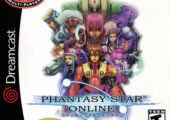
Genre: Action/RPG Developer: Sonic Team Publisher: Sega Enterprises Players: 1-4 Released: 2000
I never had a computer in the 1990s, and my only experiences online were with the scant, one-hour sessions I managed to get at the library at my university. I didn’t even get an Internet connection at home until I got my Dreamcast, and when Phantasy Star Online initially launched, I had little idea of what an online RPG would entail. However, as soon as I picked it up, I became totally captivated. My life was rapidly consumed by Phantasy Star Online. I spent hundreds of hours working on it both offline and online in the summer after it came out, and even well into the next year. It was likely the defining experience of my time with the Dreamcast.
I was one of those Phantasy Star lovers who didn’t mind the switch from the traditional RPG format, but I’m sure many longtime fans of the franchise were probably surprised when Phantasy Star Online first came out. Until then, all the games were conventional, turn-based, Japanese role-playing games that had four major releases on the Sega Master System and Sega Genesis, and despite missing a whole console generation, the franchise’s legacy endured until the Dreamcast arrived. Although the name was familiar, Phantasy Star Online surprised – and worried – fans all over the world because it was very different from its predecessors. Gone were the turn-based battles and multi-level dungeons to explore. Phantasy Star was now an action role-playing game played from a third-person, over-the-shoulder perspective, a redesign that fully embraced cooperative multiplayer for up to four players and real-time combat. There was a plot, it lacked the deep narrative development of the last game and was mostly background dressing. The main emphasis was firmly on gameplay.
But you know what? I’ll explain the plot, as I think it’s worth summarizing even though it’s secondary. Humanity launched probes far into space to find habitable planets because its home planet was about to be destroyed. They eventually found a lush, green world called Ragol. Pioneer 1, the first colony ship, was dispatched to set up a settlement. Pioneer 2 then showed up seven years later with more settlers, but a huge explosion on the planet’s surface cut off all communication as they tried to get in touch with the original colonists. To find out what happened, Pioneer 2 sent a team of hunters to the surface. That’s where the players came in.
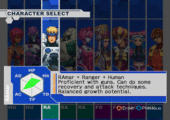
Like most web RPGs, Phantasy Star Online began with players creating their character. Though the customization might seem limited by today’s standards, at the time, it was pretty extensive and included more choices than you would expect for a console RPG. Players were able to choose between the three species: newmans, humans, and androids. Humans were the balanced well-rounded choice, newmans were better at magic but worse at physical skills, and androids had greater physical power but couldn’t perform magic. There were three different classes as well: hunters were better at melee attacks, rangers were made for ranged attacks, and forces excelled at magic but weren’t as adapt in physical combat. There were eight character presets in total, one for each of these species-class pairings, that could be adjusted with some customization. Players who selected the same character type would look largely similar, but adjustments in color and hairstyle provided a degree of individuality. Unfortunately, armor didn’t alter a character’s appearance, and costume variations were minimal. I don’t recall ever confusing anyone based on their character’s appearance, but you could tell what class and type they were easily enough from their build style.
With characters set, players then launched into a 3D world that, though limited in size and scope, seemed alive and natural, a sensation the previous 2D games couldn’t provide. Let me tell you, it was one of those seminal moments in gaming for me. The first time I connected, made my character, and beamed down to the forest area is forever etched into my mind. Phantasy Star Online was mesmerizing, a clear evolution to the franchise that did a damn good job of making players forget that the entire style of play had changed. I guess Sega saw that fans of the Shining games didn’t seem to mind the multiple gameplay styles and decided the time was right to try something new for its biggest RPG brand.
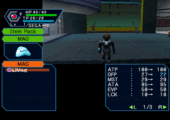
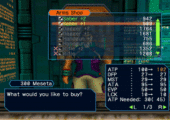
It was a daring move, especially for a new console, but taking bold, creative risks seemed to be the Dreamcast’s forte. As the the first foray into full 3D gameplay for the series, Phantasy Star Online stripped things down to its basic elements and made it less about dungeon exploring and story and focused on the action. Yeah, it didn’t feel like Phantasy Star at first, but damn it, we were playing online! That aspect was meant to overshadow the changes made, and I have to admit that it worked with me to an extent. Here I was, adventuring through different areas, fighting enemies and collecting items, and facing huge bosses – all with three other people. PC owners can chuckle at such a thought, but for consoles, this was a watershed moment. Pioneer 2 served as the game’s hub area, offering shops, healing, NPC interactions, and mission selection. Players came back here frequently, not just to restock, but also to take advantage of the shop’s rotating inventory, which changed as they grew more powerful. Since combat was in real time, when players had their energy depleted in combat, they’d return to the ship, (losing their weapon and money in the process).
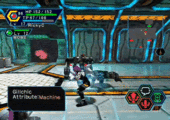
The gameplay itself evolved to mission-based romps divided into four different settings on Ragol: forests, caves, mines, and ruins. Progress in these settings was linear, and the levels still retained some of that old school charm, consisting of linking rooms and corridors; you just explored them in 3D now. As one would expect in these types of locations, some paths were sealed off by switches or required players to eliminate of all the enemies in the level before advancing. Instead of turn-based combat, encounters were wave-based, with new enemies appearing as the old ones died. This design choice is probably the one I liked the least. Though well executed, the format was occasionally too structured, and it exposed the level design’s linear structure too much. I mean, we all know RPG dungeons are linear in design – walk around, explore rooms, get items, kill monster, find the end – but it was a bit too obvious here. Sure, there were some optional areas to add some variety, but they were few, and it was hard to ever become lost in any of the four locations. The handy automap made that all but impossible because it added areas instantly as you moved around, providing a quick and clear image of which doors were still closed and which areas were already explored.
Another area that revealed some rough edges was the combat. Phantasy Star Online’s battle system was relatively simple by action/RPG standards. No, make that incredibly simple. Players could string together three-hit combos with weapon attacks, with the timing of button presses being an integral part for maximum damage effect. There was also a charged attack, but the downtime after its execution limited its effectiveness. Spells and items were cast/used from a menu, which was rather clunky in the midst of combat. Fortunately, Sonic Team implemented a shortcut system that allowed players to map six different spells or items for quick use. This was invaluable for casting healing spells quickly or using consumables. When playing online, it was particularly useful to have a moon atomizer mapped to revive fallen teammates. In the later areas, it was an absolute necessity.
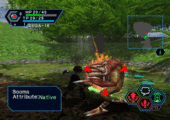
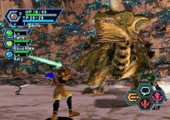
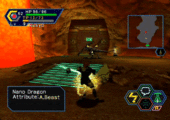
All of this clunkiness took a short bit of getting used to, and the rewards were huge. Where Phantasy Star Online truly shined was in its boss battles. These showdowns featured players going up against giant enemies with predictable attack patterns, but the spacious locations and environmental hazards ensured that combat remained dynamic. The bosses packed a wallop, and the fights had a cinematic feel to them. Who wasn’t impressed the first time they fought the dragon? Who didn’t freak out the first time they battled Dark Force? Lots of people like to thump enemies with melee weapons, but I preferred the ranged classes, such as rangers and forces because bosses would often step out of melee range. Someone had to be the healer, though!
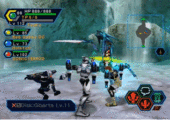
I think what made Phantasy Star Online so amazing in 2000 was its seamless integration of content between single-player and online play. All four difficulty levels and levels were available in both. The difficulty progression, however, was distinct between the two. Offline, players had to play through the entire game in order to play on higher difficulties, while online they merely had to get to a predetermined level. While the offline experience was enjoyable, the actual meat of the game was in playing online with other people. Cooperative multiplayer with others made the game so much more thrilling. Plus, tackling those bosses alone could be a herculean effort, so it was best to save them for online play with a few other players. Even one other person could make all the difference.
Communicating with the team wasn’t as hard as one might think, either. A virtual keyboard on screen was provided to chat, but nothing was more convenient than an official Sega Dreamcast keyboard, a must-have accessory for those who wanted to get every bit out of their online interactions as possible. Even if you didn’t have the keyboard, making yourself understood got easier after you spent some time with the game. There was a robust emoji messaging system (back in 2000!) that could be customized to make your own messages. Best of all, you could save the messages of other players and use them as your own! I played a lot with Japanese players, who, along with being super nice and helpful, had no trouble communicating thanks to the great emoji system.
Visually, Phantasy Star Online was one of the Dreamcast’s highlights. Although it wasn’t pushing the hardware as heavily as something like Shenmue, it was without a doubt one of the best-looking games on the system. Environments were extremely detailed, character models looked good, and animations were crisp. The spell effects were especially stunning. The game itself ran at 30 frames-per-second and was surprisingly smooth even though online play used a 56k connection. If I had something negative to say about the graphics, it was that individual environment textures lacked diversity and tended to repeat in every stage. I guess I could also apply a similar bar to the music. It was atmospheric and similar to the soundtracks of the original Phantasy Star games, but I thought it suffered from too low a track number, and many were quite short in length.
Still, it can’t be overstated just what an important title Phantasy Star Online was for Sega and consoles in general. Even months after its launch, the Dreamcast kind of struggled to establish a lasting online gaming community, unsurprising since this was before the days of Xbox Live, PlayStation Network, and Steam (in fact, the first two owe more than a tip of the hat to SegaNet and what it accomplished in such a short time). Games like Quake III Arena and NFL2K1 provided competitive online play, but Phantasy Star Online was the first to create a cooperative, persistent multiplayer world. It was also the first console-based, real-time online, multi-player RPG, and a landmark in gaming history. Despite its shortcomings, like the tedious plot and little personalization, its sheer addictiveness brought players back for more. Even after reaching peak levels and having conquered the toughest challenges, there remained a drive to find better gear, stronger armor, or simply to enjoy the experience with friends.
Ultimately, Phantasy Star Online was more than just an amazing online game. It was a Dreamcast-defining title and a harbinger of the online console game experience in general. This was the game that truly proved that Sega had what it took to bring its properties into the 3D console space, and the experience of playing online with friends at the time was just mind-boggling. Hopefully, Sega will remember the game and bring us a new Phantasy Star Online (no, Universe doesn’t count). I’d even happily throw my money at a remaster sold digitally. To this day I still find myself dreaming of once more logging on and returning to Ragol.
SCORE: 9 out of 10
Recent Comments