
Genre: Maze Developer: Taito Publisher: Sega Enterprises Players: 1-2 Released: 1988
In the before times, during the age of physical media and before microtransactions, there were these places called “arcades” where game developers would allow kids to experience thrills simply not possible at home for the tidy sum of twenty-five cents. Home consoles and even PCs of the time were not really equipped to compete with the custom boards and bottomless RAM afforded by arcade manufacturers, but we still bought and enjoyed our diluted ports because that’s just how it was. We knew not of “arcade perfect” since it wasn’t part of our vocabulary; we just hoped that our home versions of the arcade games we loved would be good enough to be playable and fun.
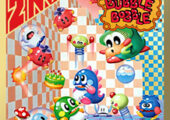
Final Bubble Bobble is not “arcade perfect,” yet it is arguably better than the arcade. With its 1988 Sega Mark III port of its 1986 arcade hit, Taito sought to make the definitive rendition of Bubble Bobble, including a host of extras which take it beyond the original. Bubble Bobble is the tale of two bubble dragon brothers venturing through the Cave of Monsters to rescue their girlfriends – because what other motivation does an 1980s arcade protagonist need? – and the game centers around blowing bubbles to trap enemies and then popping them over the course of a 100 levels. This is also where most ports end, but Taito went ahead and doubled it to 200 total levels, which is by far the biggest improvement of its Sega console game.
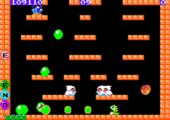
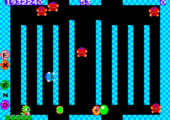
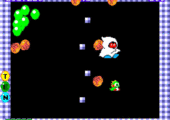
Now, some may look and think that’s nothing special. After all, Bubble Bobble is a simple-looking, single-screen arcade game which defined much of the early 1980s, and other console arcade ports of that year like Double Dragon and R-Type on the Mark III/Master System and Contra on the Famicom/NES, are more visually impressive efforts utilizing scrolling and better graphics. That is true, but up until this point, the single-screen arcade ports we had been seeing would have downgraded audiovisuals and assorted missing content, such as the missing cinematics and cement level in Nintendo’s own Donkey Kong port. Taito managed to give players “everything” from the arcade and so much more. The game may take place over a black void with relatively simplistic sprite tiles, but Final Bubble Bobble is still floods the screen with dozens of moving sprites with minimal flicker and slowdown.
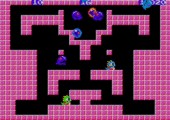
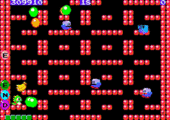
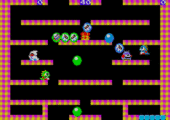
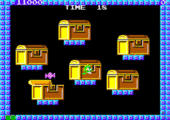
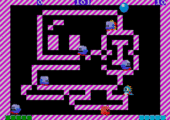
“OK, but it’s still not ‘arcade perfect,’ right?” Well, graphically, no, it’s not. While I’d say Final Bubble Bobble gets a far cleaner shave than Donkey Kong, Popeye, and other single-screen arcade ports, there do remain some slight changes. The arcade Bubble Bobble‘s platforms are arrangements of blocks with a drop shadow effect that give them a bit of a 3D look, and Final Bubble Bobble (and all other ports) omitted that effect. Likewise, gone are the larger tile sets the arcade sometimes used for the horizontal borders of the screen, which now just use the default “normal-sized” blocks. For example, stage 13 in the arcade is composed of blocks with hearts on them, and the sides are a column of hearts twice the size as the ones on the platforms. In Final Bubble Bobble, those larger heart sprites are now just 2×2 stacks of the smaller heart blocks. Other minor changes, such as the water no longer sloshing around inside the water power-up bubbles, the current level notation changing location, and the final boss being a teeny bit shorter (and the girlfriends not being present during the battle) are noted blemishes but easily overlooked. By and large, these are the kinds of details which you’d spot in a side-by-side comparison, but playing the game, you’d swear it’s the same thing since the characters, enemies, and level design all look like they were pulled right out of the arcade game.
Bubble Bobble is a game full of secrets, and as far as I can tell, they all made the trip over and then some. Where Bubble Bobble gave a hint to players after the first time completing the game and getting the bad ending — never forget your friend! — Final Bubble Bobble will instruct players to better explore specific levels. Discovering the secret hidden doors which are required to access the second half of the game and obtain the better endings help extend the length quite a bit, especially if you don’t just look it up on-line. Even if you do “cheat,” the game is plenty long, with 200 levels, and Final Bubble Bobble offers passwords after each level so you can pick up where you left off. The cutesy look belies a doable but challenging test, as navigating the often bizarre arrangements of platforms can be rather tricky at times, sometimes requiring you to bounce on your bubbles to ascend. Once you get the hang of it, most levels should only take a minute or so, but running through 200 of them is still going to take some time.
Final Bubble Bobble rewards all of the effort with some new and vastly improved endings. One thing to note is that while the European Sega Master System Bubble Bobble is essentially the same game as the Japan-only Final Bubble Bobble, the ending dialogue is abbreviated, dropping a joke or two and other chatter as part of the wonky English translation. The 1994 Game Gear port refined the English text to be more coherent, but of course, it lost a lot of the level artwork and design being shrunk down to the smaller screen. I’d say either the Mark III or the Sega Master System are the ideal way to enjoy Bubble Bobble, but you’ll be stuck with “the song” no matter which choice you make.
Taito improved Bubble Bobble here with more bosses, more enemies, more items, more everything, really, except… the game still uses its one infamous song. The Bubble Bobble theme is an overly bright and cheerful melody, just 45 or so seconds long, and you’ll likely find yourself humming it long after you’ve powered down the system. It just permeates everything. The song is the sole point of contention in an otherwise fun and excellent arcade port, and really, Final Bubble Bobble wouldn’t be “arcade perfect” any other way.
Fukio Mitsuji designed Bubble Bobble to be a fun and cooperative game that couples could enjoy in the arcades, so perhaps he figured a varied soundtrack wasn’t necessary as it would have been drowned out by the chatter of the players and other background noises. Whatever the case, he created a terrific game in Bubble Bobble, excellent alone or with a friend. Final Bubble Bobble is to me the best way to experience his vision – better than the MSX; better than the Amiga; better than the Famicom; and with all of the new bonus content, better than the arcade.
SCORE: 9 out of 10
Recent Comments