
Genre: Action Developer: Sega Ent. Publisher: Sega Ent. Players: 1 Released: 1987
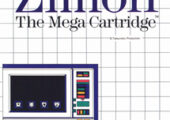
Back in the 1980s, Japanese animation really took off in popularity worldwide. Many of the studios behind some of the format’s biggest hits began to explore how they could transform the charm of their vibrant stories and unique characters into interactive experiences in other areas. One of the early examples of this was Zillion, an anime created by Tatsunoko Productions that first hit Japanese airwaves in 1987. While it did see a limited release on VHS in the United States, its most recognizable appearance outside Japan is probably from a quick cameo in Michael and Janet Jackson’s music video “Scream.” Sega released a game for Master System the same year as the anime debuted, but most players were probably unaware that Zillion was a licensed property and went into the game based on its merit alone.
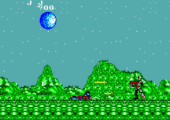
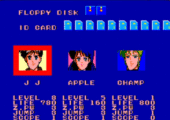
In Zillion, you take on the role of JJ, an operative of the peacekeeping force White Knights who sneaks into the underground lair of the Norsa Empire to retrieve five floppy disks packed with sensitive intel and finally shut down the base’s main computer. While there, JJ must also rescue two of his captured teammates, Apple and Champ (interestingly, the game’s manual mistakenly identifies Apple as a man, even though she’s clearly a girl in the show). JJ’s primary weapon is the Zillion laser, a powerful gun that also acts as the game’s interface. You use it to clear obstacles, take down enemies, and unlock storage units filled with essential items. Once JJ rescues Apple and Champ, they each bring their own unique skills to the table. JJ is well-rounded in all aspects, Apple is quicker and can jump higher, while Champ is tough but not as nimble. Choosing which character to control adds a strategic twist, especially as the threats within the base ramp up in the second and third areas.
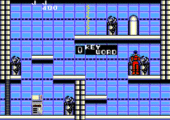
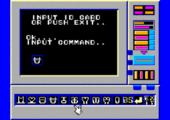
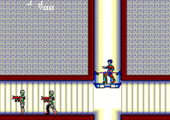
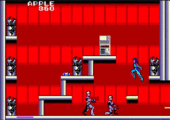
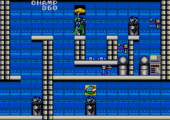
Most of Zillion’s action unfolds in a sprawling underground maze that is absolutely huge. The place is loaded with guards armed with laser rifles who keep a watchful eye on every room. Navigating the maze requires using elevators, entering small rooms, and overcoming obstacles like moving platforms, electrified barriers, security beams, and spinning turrets. Storage lockers scattered throughout these rooms offer character upgrades, health replenishments, ID cards, and clues for using terminals. Successfully entering commands at these terminals can unlock doors or disable threats. You’ll do this often, but first you’ll have to clear most rooms of enemies.
Speaking of rooms, with nearly 50 of them interconnected in a non-linear fashion, Zillion’s environment can feel overwhelming without a map. The layouts become increasingly treacherous as you delve deeper into the facility, particularly the game’s third and final section. Some areas require better jumping skills or stronger weapons to access, which is why it’s so important to rescue Apple and Champ. Luckily, JJ does at least have some talents to get him that far, and you can reprogram certain devices to disable security systems, introducing an unexpected layer of problem-solving. Designer Kotaro Hayashida was smart in the way he designed interactions with the computers to advance because beyond just using the computers to open doors, you also can program them to stop the turrets, lasers, and electric fields.
Looking at how Zillion is designed, it’s easy to see why some people might be quick to compare it to Nintendo’s classic, Metroid. It’s true that both games feature classic side-scrolling exploration, a gradual buildup of power, and the thrill of uncovering hidden items. Moreover, they both encourage players to take their time and experiment as they venture into new areas in search of secrets. That said, the similarities don’t extend much further. Zillion isn’t just a solitary trek through alien caverns; it’s a mission packed with hostile guards. As you progress, you’ll eventually team up with your companions, which is a clear break from the theme of isolation and loneliness found in Nintendo’s blockbuster. Plus, Zillion’s high-tech setting, complete with electronic traps and puzzles, gives it a unique twist that is more reminiscent of Impossible Mission than Metroid. I’m sure Hayashida was inspired, to say the least, by that computer classic.
The scope of both games also varies quite a bit. While Metroid allows players to explore an entire planet as they gather upgrades, Zillion keeps you within one expansive installation. Sure, you can enhance your weapons and stats, but that doesn’t often lead to vast new areas to explore. Furthermore, though you might find yourself backtracking, it’s usually by choice rather than a requirement due to obstacles.
Even with these influences, Zillion still manages to shine on its own. The graphics are sharp, the controls are smooth, and the soundtrack is catchy. The rescue system adds a fun twist, letting players switch between characters, each with their own unique strengths, and the wealth of hidden content really rewards those who take the time to explore thoroughly. I do wish there were a bit more depth to the character system beyond them functioning mostly as additional life bars. Not that such a function is minimal here; it’s not. Zillion only allows three continues, so having the extra characters gives you a chance to avoid a quick end if you manage each one correctly. As useful as that is, though, it seems like a wasted opportunity, another chance the sequel never capitalized on.
The biggest drawback Zillion has is the absence of a save or continue feature. Given that the game keeps track of numerous doors opened and all the items collected, I’m sure that implementing a password system wouldn’t have been easy, and I suppose a battery backup was too much to ask for. Phantasy Star, which shipped the same year, had one, but it retailed for $100. That kind of price would have made Zillion unsellable. But without either option, players are left with the challenge of completing the entire game in one go.
As so many games of the era did, Zillion uses this limitation to really emphasize the need for preparation and practice. Trust me, creating a map can help avoid aimless wandering and make future attempts more efficient. Your initial playthroughs often turn into practice runs to get a feel for the layout, with a successful run taking a couple of hours, even after you’ve gotten the hang of it. For those ready to invest the time, Zillion’s mix of challenge, atmosphere, and exploration is genuinely rewarding, even if its lack of a save feature keeps it from reaching its full potential.
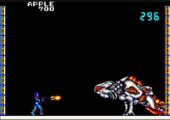
I also must admit that the game’s design is a bit underwhelming. After gathering all the necessary disks and initiating a timed escape, the White Knights face off against a massive mechanical lizard that breathes blue flames. It tries to serve as a climactic last act to the game, but it’s the only boss in the entire game. The encounter only makes you wonder why it’s there in the first place since nothing up to this point prepared you to expect it. Also, why isn’t the final boss the main leader of the Norsa forces, Baron Ricks? Completing the escape confirms that the mission was a success, but Ricks only makes a brief appearance in a simple cut scene when you die. He never interacts directly with you, which is unfortunate. One would expect the final battle to be against him, and it’s a bit anti-climactic that he never appears during gameplay. You’d think he’d be saved for the sequel, but as I explained in that review, nothing of the kind happens since you only fight the commander of that particular base and not Ricks himself.
Overall, Zillion is an incredibly fun game. It has a futuristic vibe, presents a real challenge, and demands a blend of skill and memorization. If you’re someone who thrives on challenges, you’re in for a treat! I wholeheartedly recommend it, especially if you have the patience to navigate its labyrinthine levels. The atmosphere is simply enchanting; it draws you in and keeps you engaged. I really enjoy the gameplay mechanics, like exploring the base, dodging traps, and uncovering secrets and power-ups. Just a heads up, though: make sure you approach Zillion understanding that there is no way to save your progress when playing on an actual cartridge (emulation will solve the issue with save states). However you play it, Zillion is a wonderful title that really deserved more of a chance to evolve. The sequel was actually a step backwards, and it’s a shame the Genesis never got a chance to give the series the 16-bit treatment.
SCORE: 7 out of 10
Recent Comments