
This interview originally appeared in the February 1990 issue of Beep! MD magazine. In it, the Deputy General Manager of Sega’s Consumer Business Dept., Shigeo Kamata, and its Director of R&D, Hideki Sato, discuss a wide range of topics, including the Mega Drive finally appearing to hit its stride, the Mega Modem, the start of the Sega Technical Institute, and more. While not particularly deep in content, the interview presents an interesting view of Sega’s early trepidation with the Mega Drive about finding an audience and satisfying consumers. Sato particularly seems concerned with what will please buyers, and one can sense his genuine desire not to disappoint them.
* * *
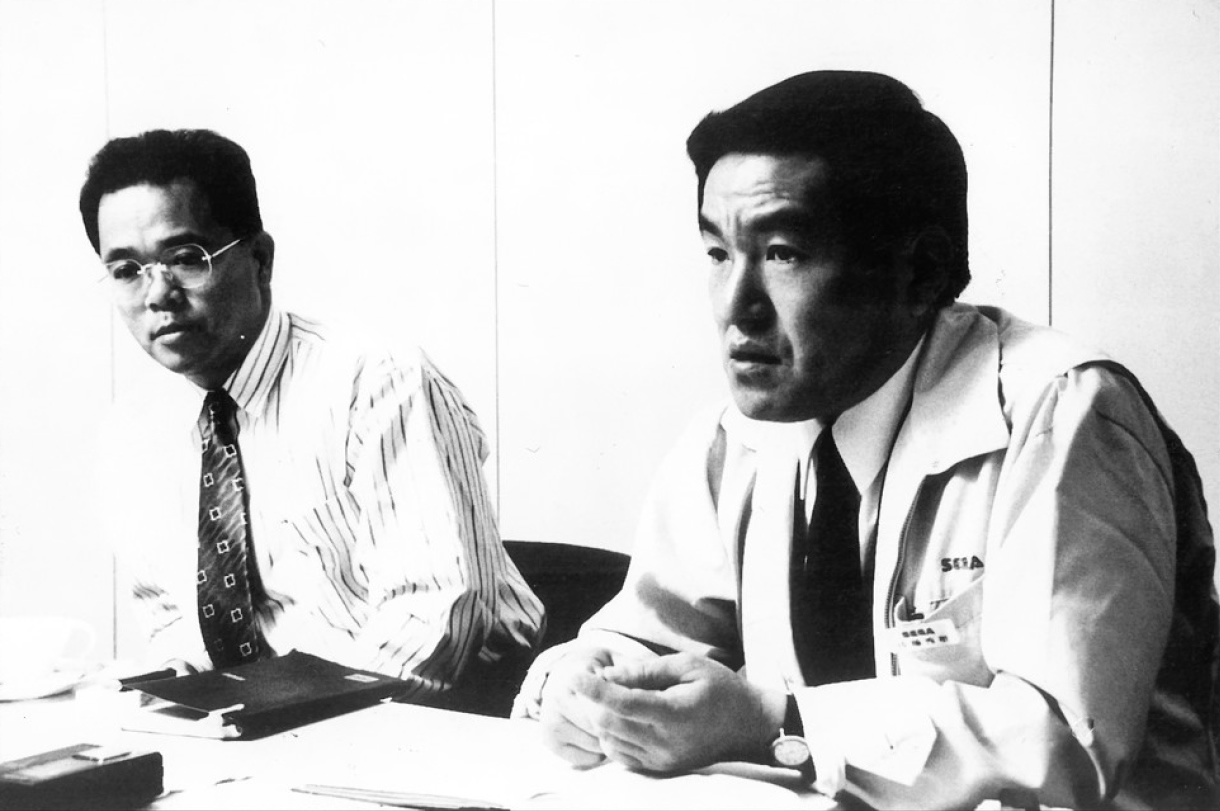
In this issue, we’re excited to bring you a conversation with Mr. Sato and Mr. Kameda, two central figures behind the development of SEGA’s Mega Drive software. They discuss the challenges and joys of working on the Mega Drive, insights into game development, and what lies ahead.
Last December, seven games were released at once, and this year is finally the year that the Mega Drive will show its full potential! So, at the beginning of the 1990s, a new era of games, we asked Sega about its enthusiasm for this year.
Is Sega a little different this year?
The Modem Will Finally Release This Spring
Beep! MD: How many Mega Drive units were shipped in 1989?
Kamata: There was the Christmas sales season, and while we don’t yet know the final figures, I believe it has surpassed 800,000 units. It was a bit more than what we expected.
Beep! MD: Speaking of expectations, what happened to the modem?
Kamata: From the monitoring results we conducted in the fall of last year, many people said they wanted it released as soon as possible. At the same time, we also received many requests saying, “We want it released like this.”
Initially, we had planned a November release, but after looking at those results, we decided to improve what needed improving and aim for a better launch overall. That’s why we postponed the release to this spring.
Beep! MD: What part of the preparation of downloadable software are you most concerned about?
Sato: The main reason we delayed the modem’s release in the first place was because we wanted to have a sufficient number of downloadable game titles ready. Even if we released the hardware first, it wouldn’t be very appealing without games to play. It’s still unclear whether it will be five or six. However, if we are going to release it, we want to ensure we have a proper system in place to supply software.
 Beep! MD: What kind of software do you plan to offer as downloadable games?
Sato: Right now, we have a lot of 1-megabit and 2-megabit games available. Using a modem, accessing a 256K game takes about three to four minutes. Well, that’s probably about the limit for phone charges, but if we consider what kind of games could be made with that amount of capacity, it would likely be puzzle games or text-based RPGs that don’t rely heavily on graphics. That will probably be the main use at first.
Beep! MD: Modems aren’t just for games. They can also be used as communication terminals, like Mega Anser (home banking using the Mega Drive).
Sato: The Mega Modem is no different from a normal modem. They’re all heavy (two-way communication systems) at 1,200 BPS (BPS is a unit of transmission speed. They can send and receive 1,200 bits of information per second). They’re more than capable of handling Mega Anser-type uses.
Kaneda: For now, we should be able to announce the price and other details soon.
The Arcade Power Stick Will Release Around April
Beep! MD: I heard that the Arcade Power Stick for the Mega Drive is also scheduled to be released soon.
Sato: It’s mostly finished, and we’re going to show it at the CES (Consumer Electronics Show) held in America (a large-scale game machine show held from January 4th to 8th). I think we’ll be able to announce it soon. The actual release date will probably be around April. The price has not been decided yet, but it should be a good deal compared to other joysticks.
Beep! MD: What kind of functions does it have?
Sato: There’s a start button and three trigger buttons, each of which has a turbo function. The control stick uses the same microswitches as commercial models. By narrowing down the functions, we hope to provide a product that is easy to use while keeping the price as low as possible. I’m sure it will live up to your expectations.
Peripherals

Beep! MD: I heard that software development preparations are steadily underway for FDD (floppy disc drive) and CD-ROM, but are there any other surprising peripherals being announced this year?
Sato: We are currently considering creating software that is unique to FDD. The same goes for CD-ROMs; we have an idea, but that alone won’t lead to sales. As I’ve said before, the hardware is already complete, but I’m not sure I’m satisfied with the software. It’s quite difficult.
When it comes to hardware other than this, the first thing that comes to mind is whether people really need it. Even when it comes to drawing software and graphic tools, it’s questionable whether people really need them. Sega is researching and developing in search of every possibility. I’d love to hear from readers about what they think would be great to have.
Beep! MD: Isn’t FDD one way to solve the memory issue?
Sato: One megabyte (the capacity of a two-HD disk on PC) disk can hold roughly eight megabits of game data. Phantasy Star II and Vermilion are six megabits, but even if eight-megabit games come out in the future, the price of semiconductors should be lower by then than it is now. To take an extreme example, the price of an eight-megabit cartridge and a one-megabyte disk may not be that different. In that case, is it really just capacity that will determine the number of disk-comparative games? It is difficult to say whether it can be differentiated from current games.
Beep! MD: One approach is to separate the system and the scenario, like in the PC version of Sorcerian.
Sato: Well, you could just put in backup RAM (laughs). If we don’t think ahead and consider future developments, then the hardware won’t grow. It seems that Mega Drive users have high expectations for the FDD, so if we don’t provide something that meets their expectations, we’ll get scolded (laughs). We are working hard to meet those expectations. Please be patient.
Is the Software Lineup Alright?!
Beep! MD: A lot of software titles were released in December, and although we won’t be able to reach that number, we are hoping to exceed last year’s sales each month.
Kamata: Sega’s development structure has also changed since last year, and now there are more staff working on consumer products than commercial products. In that situation, I think there will definitely be an improvement in both quality and quantity compared to last year. I think that improving quality is especially important for Sega.
Beep! MD: I would like to know if there is any software that Sega recommends for the first half of this year.
 Kamata: It’s definitely Phantasy Star III, which is scheduled to be released in April, and then there are some that appeal to a younger generation. We would also like to focus on our lineup of games like Ultraman and Magical Hat. We’re thinking games that will be enjoyed by our current customer base and also by children, targeting a wide range of people.
Beep! MD: Will there be more ports like Sorcerian and Ghouls ‘n Ghosts this year?
Sato: We plan to continue supporting ports of PC software this year as well. There will be users who bought the Mega Drive looking forward to it.
Beep! MD: What about arcade ports?
Sato: Of course, we’ll be putting effort into these, too.
Beep! MD: What about Sega’s unique character line?
Kamata: This year, we want to create more original works than ever before, games with characters as the protagonists that everyone can love.
Beep! MD: In that sense, Phantasy Star seems like it will become a classic.
Kamata: I hope that Vermilion can become a franchise like Phantasy Star.
Establishing a Software Development Company in America
Beep! MD: In Nikkei Business Daily, Sega announced that it had established a software development company in America.
Sato: When you think about the market in America, a development system that relies solely on Japanese sensibilities inevitably has limitations when it comes to software creation.
Kamata: After all, software that suits the American market is better made in America. So, that’s why we’ve tried it. We plan to make software for commercial and consumer use, and staff from Japan and staff hired locally will work together to create the software.
Sato: It means we’re going to take a more positive approach.
Beep! MD: When is the first game scheduled to be released?
Sato: It will take a lot of time. Just the production will take at least a year.
Beep! MD: Of course, it’s possible that software made in America will be imported to Japan.
Kamata: Exactly. I think that will happen.
Sato: Also, we will receive more information about PC software over there, both in quantity and quality than ever before. We plan to make good use of that information in our software development and make contracts with overseas third parties who create good software in order to revitalize the Mega Drive software market.

Beep! MD: How far along are the talks on contracts with American software makers?
Kamata: They’re currently in the works. I think we’ll be able to make an official announcement soon.
Sato: For 8-bit games, we’re in the process of making contracts with European software makers. They’re the companies over there that make software for the Amiga and the like.
Beep! MD: Will European games be well received in Japan?
Sato: There’s no fundamental difference as far as a game being fun goes. But a genre that can vastly differ is the RPG, because the historical background is completely different. For example, even the entrance to a dungeon has a coat of arms, and it has a real meaning. They have a historical background. Naturally, the quality is different from Japanese RPGs, which have a short history.
Mega Drive 1990
Beep! MD: Finally, I’d like to hear about Sega’s goals and aspirations for this year.
Kamata: To make the Mega Drive the number one video game console, and to continue to provide software that consumers can enjoy and never get bored of – those are the two points. We want to improve the quality of the software, of course, and with the expansion of third-party software, I think we’ll be able to provide a better software supply. Please look forward to it.
Sato: When it comes to software creation, we want to provide a wide range of software, from those for enthusiasts to those that are popular with the general public. So, I want to expand the gaming population, for example by using a character called Magical Hat. To be honest, I’m not sure if just improving the quality will satisfy users.
With the aim of creating the next RPG, we will, of course, continue to make what is popular now, but we also want to keep looking for something beyond that and continue to work hard on software development. If we don’t do that, I feel like even next year’s video game market will be in jeopardy.
Our thanks to Andrej Preradovic for his help translating this interview.
Recent Comments