
Genre: Action Developer: Sega R&D 1 Publisher: Sega Ent. Players: 1-2 Released: 1987
If you were even half awake during the 1980s, you were aware of just how popular ninjas were in the U.S. The stealthy warriors were everywhere, and video games were no exception. Sega jumped into the crowded world of shadows in 1987 with Shinobi, an arcade game I simultaneously loved and hated. On the one hand, the ninja action was fast and satisfying, and there were loads of enemies to kill across all kinds of cool stages. On the other hand, the game was hard, damn hard. That relationship persists to this day.
Conceived by Yutaka Sugano, who had just finished the arcade version of Alex Kidd: The Lost Stars, Shinobi emerges as a defining moment in arcade gaming history, blending the allure of ninja mystique with tense and fast-paced gameplay. Released on Sega’s System 16A board, it diverges sharply from its Sega siblings like Action Fighter and Fantasy Zone, offering a darker, more somber experience that resonates deeply with battle-hardened arcade goers seeking a challenge. This is a game for people who like to cut things (and people), and there’s no shortage of opportunities to hack and slash. Oddly enough, the gameplay is a stark contrast to the title, as there is no stealth involved whatsoever. Shinobi is straightforward and blunt in its design: kill everything that moves.
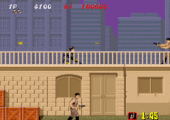
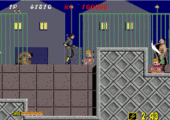
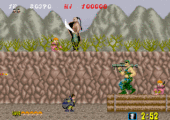
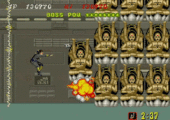
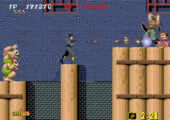
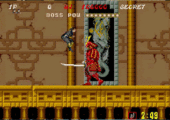
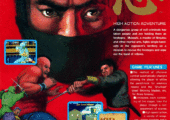
Shinobi is a game that invites players into the stealthy world of ninjas armed with martial arts moves and a seemingly bottomless supply of shurikens. It follows the typical side-scrolling action of many titles from its era, and its plot is just as ‘80s as its gameplay. Players step into the sleek black garb of Joe Musashi, a ninja master who wields deadly martial arts and mystical powers, to embark on a dual mission across five missions series of static yet atmospheric backdrops, from bustling city streets to ominous hideouts, each teeming with adversaries and secrets to rescue kidnapped children and dismantle the nefarious terrorist network, Zeed. The missions are divided into stages that traverse a wide variety of terrain as Mushashi battles his way to the boss. Boss battles loom large here, showcasing Shinobi’s impressive range of foes, from massive, armored warriors to helicopters pumping out legions of enemy ninjas. The game pulls no punches, and the first boss alone is probably responsible for most of its quarter-crunching early on. Like so many other balls-to-the-wall arcade games from this period, success required learning patterns and acquiring muscle memory. Beating Shinobi was like finishing Ghosts ‘n Goblins, you earned that victory through lots and lots of practice.
Luckily, Mushashi has more than just chops, kicks, and some throwing stars up his sleeve. Using a third button, players can harness potent ninjutsu, or ninja magic, and unleash devastating attacks that clear the screen of enemies and inflict substantial damage on bosses. Three different spells are available (doppelganger clones, thunderstorm lighting bolts, and tornado whirlwinds), and they can be used once per stage. They’re great for getting out of a jam when there’s just too much happening onscreen, and while you’ll get a bonus for finishing a stage without using it, you’ll find it definitely comes in handy. Moreover, there’s a nifty POW icon (remember when every ’80s game had a POW icon?) that upgrades the shurikens into a gun and turns Musashi’s martial arts attacks into a razor-sharp katana. Yes, when things hit the fan, Joe pulls out the heavy hardware.
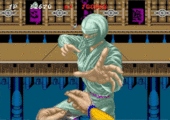
One of Shinobi’s standout features is its dynamic verticality, allowing Musashi to leap to areas above and below him. This mechanic is often crucial for rescuing hostages and uncovering power-ups, as stages often scroll in different directions, and players will sometimes find themselves having to backtrack to find that one missing hostage to proceed through the exit. Additionally, there are bonus rounds between missions that are intended to provide brief respites from all the action and challenge players to showcase their marksmanship in a first-person shuriken-throwing frenzy to earn an extra life. I find they can be just as intense, as swarms of ninjas dodge your shurikens and leap towards the screen.
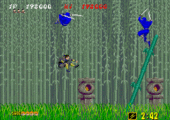
As I mentioned earlier, Shinobi has a much darker tone than Sega’s other System 16A board titles, and that applies to the presentation as much as the gameplay. The environments are more earth-tone in color and aren’t as bright, the perfect setting for ninjas to hide in, I suppose, though the ones in this game are clad in colors bright enough for the Power Rangers. The static backgrounds haven’t aged that well, and I remember noticing their lack of parallax even back in 1987. I’m a real fan of multi-scrolling backgrounds, and the lack of movement in Shinobi’s stages always irked me. That’s just my personal preference, of course, and the overall level design helps offset this minor nitpick. Thankfully, the visuals are accompanied by a captivating soundtrack infused with mystical Eastern motifs that help immerses players in Shinobi’s martial arts-inspired world, complemented by great sound effects and vocalizations.
Aside from the ninja theme, a big part of what made the original arcade Shinobi so popular was the fact that it was originally distributed as a conversion kit. These kits were cheaper and easier to set up than a dedicated cabinet, and Sega’s North American coin-op arm, Sega Enterprises USA, had already seen big sales with its first kit, Choplifter. Kits became more common as the 1980s went on, and the combination of addictive gameplay and affordable conversion kit price propelled Shinobi to become a worldwide blockbuster, and Sega claimed that it was the bestselling kit since Universal’s 1982 hit, Mr. Do!.
While the arcade version will always remain iconic, it’s important to note the improvements the Sega Master System adaptation introduced. Directed by the guru of 8-bits at Sega, Katsuhiro Hasegawa, it likely inspired Noriyoshi Ohba during development the Genesis sequel, The Revenge of Shinobi, by introducing enhancements such as a health meter to give players a chance to progress further without succumbing to instant defeat. However, even with these modifications, the Master System version of Shinobi could still be as hard as the arcade original, prompting some players, including scrubs like me, to often resort to cheat codes to conquer its relentless difficulty.
Overall, Shinobi is a testament to the enduring legacy of arcade classics, delivering a quintessential ninja experience that remains as exhilarating today as it was in the heyday of coin-op gaming, blending fast-paced combat, intricate level design, and nostalgic charm into an adrenaline-fueled adventure that still a blast to play. Whether reliving fond arcade memories or discovering its challenge, players will find that Shinobi hits that sweet spot of classic Sega coin-op action that we loved back in the 1980s. Ninjas are still cool, and I still smile when my ninjutsu wipes out an entire screen full of enemies. This was the start of Joe Musashi’s legendary tale that went on to span multiple consoles and that continues to this day. It was one hell of a debut, and it even after all these years, he’s still the ninja master.
SCORE: 9 out of 10
Recent Comments