
Genre: Shmup Developer: M2 Publisher: Taito, Columbus Circle/Strictly Limited Games Players: 1 Released: 2021
In my earlier review of the 2019 Mega Drive Mini version, I called it a “timeline correction:” a native Mega Drive port that finally brought Darius to Sega hardware. The 2021 cartridge transforms that foundation into something far more ambitious, correcting longstanding balance and scoring problems while even fixing issues such as power-up orbs becoming trapped inside stage geometry and foreground structures. It’s M2’s second pass over Hidecade’s work, with all three arcade revisions refined and expertly tuned for single-screen gameplay.
To summarize the arcade Darius revisions contained in this officially Taito-licensed cartridge release:
- OLD is the original one and has every main weapon major upgrade raising boss HP significantly more than your firepower, so leveling up comes at high cost. Standard progression works against you too. By Fatty Glutton (Piranha) on the early routes you’re stuck with a weak Laser, which has a low bullet-count ceiling and runs dry against its spread attack. Veterans learned to stop at Missile-Max to facilitate 1CC runs.
- NEW halves the boss-scaling problem but still leaves Fatty Glutton brutally tanky once you’ve upgraded your main weapon, so the late game eases up while the early wall stays.
- EXTRA was Taito’s full rebalance designed both to extend the game’s arcade lifespan and improve profitability for operators, with input from Zenji Ishii, former Gamest editor and a national-record Darius player. Fatty Glutton became a fair fight, post-Glutton boss HP scaled properly against power-ups, Laser damage went up, and ground turrets got real HP. Item distribution was reworked across the zones, and Iron Hammer’s safe spot and the Great Thing point-blank kill both stopped working.
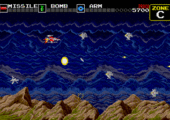
EXTRA was controversial in the arcades. Some of what Taito layered on top of Ishii’s fixes was aimed at pulling more credits per player: gold screen-clearing capsules were limited to one per zone, with the exceeding ones swapped for score-bonus orbs of random value, and added red roe that aggressively track you before boss fights. The harshness increase affected many zones. For instance, Zone M, the central-route asteroid field, threw debris and airborne enemies from every angle, and underwater routes added Tabok C4 turrets firing walls of bullets upward. Japanese players flagged Zone L as “punishment to even select.” Upper routes like A-B-D-G-K drown you in blue Arm capsules while starving greens, so you hit Fatty Glutton shielded but underpowered.
Other changes were more positive. The Remained Player Bonus pays a million points per ship still in stock at the all-clear, rewarding clean no-miss runs through score, the same way Darius Gaiden later would reintroduce. EXTRA also tightened the boss fights themselves, narrowing safe lanes and cutting the comfortable spots where you could camp and milk timeout cubes for score. The Zone X Octopus is one example: its fixed three-way flame spread became a four-way one whose initial angle tracks your ship, closing the old safe lanes. These were genuine improvements, less gimmicky and more demanding.
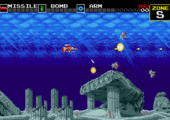
M2’s Darius Extra Version makes it right. Zone M’s airborne formations are slightly reduced, so you’re still dodging asteroids and shooting enemies but no longer dying due unfair circumstances. Underwater, turrets no longer fire a continuous wall, so you can weave between patterns instead of eating shield hits. Weapon tuning evens out the worst route imbalances. The denser patterns, faster Wave upgrades and scoring system of the EXTRA version in this single-screen rendition give the game a denser, more aggressive rhythm that at times feels spiritually closer to Darius Gaiden than to the original three-screen Darius, especially when paired with higher auto-fire settings like 20 or 30 Hz that maintain constant forward pressure.
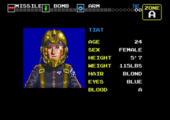
M2 revised and fine-tuned the three arcade versions for single-screen gameplay with the help of superplayer KZS, known for his arcade Darius clears at Takadanobaba Mikado Arcade Center, refining durability, rank, collision, and weapon behavior. Compared to the Mega Drive Mini release, PROCO (Normal) is untouched, but TIAT (Easy) no longer powers you down on death, the trade-off being that TIAT clears don’t hit the score boards. EXTRA is the only mode with three continues; OLD and NEW give none. Auto-fire is set per button row at 10, 12, 15, 20, or 30 Hz for the ABC and XYZ independently. Each arcade revision and boss mode keeps its own high-score table, and soft reset is now possible with A+B+C and START. On real hardware the controls are tighter than the Mini, with no input lag.
What ultimately makes Darius Extra Version so compelling is how cohesively its mechanics fit together. The branching map constantly forces decisions about route difficulty, boss selection, weapon progression, and scoring opportunities. Every stage delivers dense enemy formations supported by responsive controls and refined collision tuning that often feel closer to later Darius games than to the harsher arcade original. The bosses remain spectacular mechanical sea creatures with destructible fins, claws, and armor sections, each worth 30,000 points when destroyed, forcing constant risk-reward decisions between maximizing score and simply surviving the fight. Combined with the three arcade revisions, Boss Rush variants, hidden Arcade Mode, and alternate boss structures, the cartridge has extraordinary replay value.
The Arcade Mode I mentioned is activated by entering R, L, B, R, L, B, L, R, B at the title screen, after which “ARCADE MODE” appears onscreen. Coins are inserted by holding Start and pressing Down. The mode restores a far stricter arcade-style ruleset with separate ranking tables: no pausing, no soft reset, rapid-fire limited to 10 Hz, PROCO and the original 11-boss structure only.
The cartridge also expands the boss structure. Two arrangements existed on the Mini, and now you can pick between them per revision. The arcade reused 11 bosses across routes due to ROM size constraints. “Arcade Bosses” keeps the original structure; “26 Bosses” gives every route a unique boss, making the branching map a real set of choices. Some PC Engine-exclusive bosses feel revised: Zone J’s Steel Spine behaves more like its canonical later patterns in Darius sequels than the patchier Super Darius version. Game Mode covers six setups, Normal and Boss Rush for each of OLD, NEW, and EXTRA. Boss Rush drops one of each color power-up per kill, so early bosses meet you weaker and force different strategies. Boss Type toggles separately.
The sound is also significantly improved over the Mega Drive Mini’s Darius (2019). M2 commissioned sound artist WING☆, who has occasionally collaborated with Yuzo Koshiro and who was responsible for the renditions of the Space Harrier and Space Harrier II themes on the Mega Drive Mini 2, to rebuild the FM mix, bringing back low-end and increasing stereo separation. Music tracks “Captain Neo,” “Chaos,” “The Sea,” and “Boss Scene 7” all sound markedly better here, on par with the arcade originals. Where the Mini release used low-quality PCM samples for SFX including the “WARNING” cue, the cartridge recreates them on the YM2612 and DCSG with higher fidelity. It also restores the arcade boss explosion sequence, the rolling “BOOM, BOOM, BOOM” off-screen detonations that had been flattened to standard sounds.
Even the hidden soundtrack player received additional refinement in this cartridge release. Entering Up, Up, Down, Down, Up, Up, Down, Down in the options menu unlocks a dedicated music test that now includes a repeat function absent from the Mega Drive Mini version, allowing tracks to loop continuously rather than automatically cycling through the Hisayoshi Ogura’s soundtrack playlist.
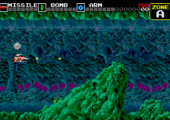
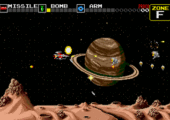
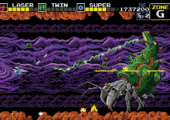
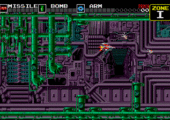
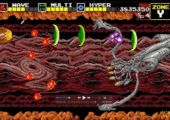
Visually, Darius Extra Version initially resembles the Mega Drive Mini release, but the cartridge contains numerous technical refinements beneath the surface. Graphical glitches, visible CRAM dots and edge-case bugs on real hardware were fixed. The EXTRA revision also requires additional on-screen sprites and more CPU power, which in the arcades had introduced instances of noticeable slowdown but here they are presented by M2 with the same smoothness of the OLD and NEW revisions. Sprite flicker is minimal, palette work is superb, and massive bosses such as Green Coronatus undulate like the sea creatures they’re modeled on, thanks to unorthodox, dynamic use of the console’s VDP and its VRAM. Attack geometry is far more accurate than any other Darius on fourth-generation consoles, boss projectiles spreading and curving with a smoothness usually only seen on arcade hardware, while keeping the original presentation quality intact: title screen, fonts, and all the arcade endings in full.
Darius Extra Version is one of the Mega Drive’s most significant modern releases and easily the most complete home interpretation of the original Darius. By combining the arcade game’s multiple revisions with careful re-balancing, sharper controls, and a more intense single-screen presentation free from the original checkpoint system, M2 created a version that often feels more refined and coherent than the arcade releases themselves. The level of technical care and historical attention throughout the cartridge is extraordinary. A must-have for Mega Drive owners and one of the finest shooters ever released for the system.
Thanks to Tony H. for the Game Genie codes and button sequences that allowed me to explore in full each mode and all options of this game, which greatly supported the writing of this review.
Score: 10 out of 10
Recent Comments