
Genre: Platformer Developer: Argonaut Software Publisher: Fox Interactive Players: 1 Released: 1997
The transition from 2D to polygonal 3D was a quantum leap, probably the largest the gaming industry will ever see. Although this transition was gradual, with the arcade cabinets of the early nineties being among the true pioneers, some of the most exciting developments came with the release of the first home consoles that could process true 3D graphics and gameplay. The Sega Saturn was one such console, even if its 3D capabilities were ultimately less successfully exploited than its closest competitors. Notorious for not having a 3D Sonic platformer of its own, Sega’s 32-bit console nevertheless received a suitably anthropomorphic alternative, in the form of Croc: Legend of the Gobbos.
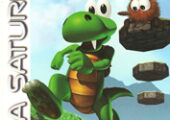
Nintendo fans can be forgiven for taking one look at the cover art and thinking that the titular character is a rip-off of the Mario series’ Yoshi. This isn’t a coincidence. Developed by British studio Argonaut Software, the game that became Croc was originally pitched to Nintendo as a 3D platforming/racing hybrid featuring the Japanese company’s most famous reptile. Prior to this, both companies had worked together to produce Star Fox for the SNES, using the Super FX graphic chip that Argonaut themselves designed. Nintendo, however, had never let a third-party touch their own characters and, as the founder of Argonaut later pointed out, it wasn’t about to let Argonaut buck the trend. It’s also true that Nintendo was developing its own pioneering 3D platformer, Super Mario 64, and probably had little incentive to support another developer in doing the same. The deal collapsed, but the project – and the crocodile – lived on.
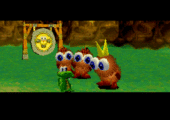
Croc begins with a real-time cut scene that sketches the story of our heroic crocodile and the conflict to come. As a hatchling, poor Croc seems to have been abandoned. Sailing down a river in a basket, he’s discovered by the furry Gobbos, who are essentially two fluffy-looking sprites overlapping each other, coupled with a pair of expressive eyes. The Gobbos adopt Croc, teaching him how to run and tail-whip. It’s not clear why, until the evil Baron Dante appears, locking all of the Gobbos in cages while Croc is spirited away by a friendly bird. The set-up (and the rest of the story) is no deeper than other platformers of its era and arguably has less personality. Still, it’s a good enough introduction to the world of Croc – and an excellent introduction to its music.
It’s probably not an exaggeration to say that anyone who has ever played Croc remembers the menu music. With its lively, mariachi-style trumpets, it has to be one of the most preposterously upbeat tunes of its time, and it manages this without ever becoming grating. With some of the game’s fully 3D levels in the background, the main menu also gives you a taste of what’s to come. Each of the four worlds consists of six regular levels, two boss battles, and one secret level. Hit start, see the Crash Bandicoot-style world map, and the journey begins.
Croc can run, jump, tail-whip, climb and stomp. He can also swim, although perhaps surprisingly, swimming is a fairly rare occurrence. What you’ll notice before the actual moveset, however, is how Croc controls. Forward to move forward, left and right to rotate in those directions, and back to walk backwards. Like Chris Redfield and Lara Croft, this crocodile uses tank controls, and it’s entirely possible that your enjoyment of the game will live or die by this. Super Mario 64 launched a year before this game, and Spyro the Dragon would come a year afterwards. It’s not unfair to say that Croc’s control scheme probably felt dated even back in 1997, and it certainly isn’t in line with the platforming conventions of today. Being someone who’s never been offended by tank controls, I find they make the moment-to-moment gameplay immediately more involving and original than many other platformers – but again, your mileage may vary. Croc also supports the 3D Control Pad, although the general consensus is that it only makes movement stiff and imprecise.
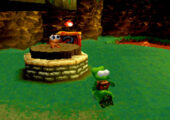
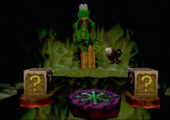
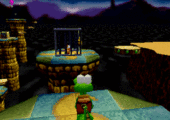
The levels of Croc are essentially a string of sparsely-populated “rooms,” separated from each other by doors. By the end of the first level, you’ll have worked out that your goal is to collect the six Gobbos in each level, with the sixth only reachable by going through an optional special door and completing a platforming challenge. These special doors require five coloured gems to unlock, and many other doors need a traditional gold key, so it’s not just your furry friends you’ll be hunting for. Enemies are mostly mindless, prone to wandering around in circles or rushing at you imprecisely, although they become somewhat more threatening in later levels. After whacking them into oblivion with your tailspin, they all respawn after about 10 seconds or so, a part of the game’s tempo which is still fairly annoying.
Among the most impressive things about Croc, and something that makes it worth playing today, is how thoughtfully most of these rooms are designed. In nearly every case, you’re given a clear idea of where you should be heading or what you should be aiming for. Croc never asks you to make a leap of faith or to find your way up a hillside without a signpost. And while the game’s core mechanics are exceedingly simple, both the level design and the moment-to-moment gameplay often feel satisfyingly deep. It all feels very modern, as if the small team of developers had entire rooms of testers to understand the way players would be looking and thinking as they played. If you get frustrated with Croc, it might be because of the controls, the respawning enemies or a particularly troublesome obstacle, but never because of confusing or unfair level design.
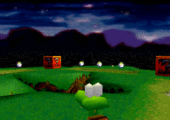
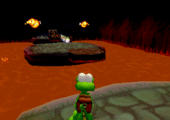
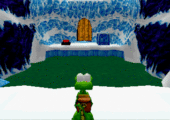
Less impressive are the environments themselves, and the often conspicuous obstacles you’re up against. There’s a forest world, an ice world, a desert world, and a castle world; none of which can claim points for originality and all of which have a loneliness that clashes with the otherwise whimsical tone. Some effort has been made to make these environments match their obstacles, like the slippery ice platforms in the ice world. More often than not, however, the game slaps down giant floating cogs or disappearing wooden rafts and calls it a day. This doesn’t make navigating those obstacles any less satisfying, but it does lack the visual and mechanical cohesion of a truly great platformer, and leaves Croc feeling more like a prototype at times. On the plus side, the music, which is wonderfully memorable, does succeed in shoring up each world’s identity, giving them their own distinct feel.
If you like challenging bosses, you won’t find them here. Croc features eight of them (plus one secret boss, unlocked by collecting every Gobbo), and they’re simplistic to the extreme. The strategy for most of them is to wait for the enemy to strike, evade, and then strike right back during a clearly-telegraphed cooldown animation. That said, they’ll crush Croc quickly enough if you’re not paying attention, and they’re bookended by charming cut scenes that do a lot to bring this world (and its villains) to life. There is no dialogue in Croc, only cartoonish exclamations and evil snickering. Some of these inflections, like Croc’s adorable kersplat or the way he stammers when being whisked off to a new world, are liable to stay with you for life. These are small details, but ones that, along with the music, help add flavour to a game that can otherwise feel a little abstract and underbaked.
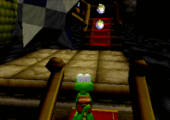
These days, Croc is one of the lesser-known platforming games of the 1990s. In 2025, it received a remaster for modern systems which, with its modern controls for those who want them, may be the best way to play it. The game was originally designed with Sony’s PlayStation in mind, and while the Saturn version is certainly no slouch, it suffers from some of the sloppiness that affected many of the console’s ports. Chief among these is a strange visual bug which is triggered when you switch on your console with the game disc already inside, resulting in the vanishing of Croc’s snout, as well as other character geometry. Booting up the game from the Saturn’s BIOS avoids this unexpected body horror. The visuals are also grainier and more sombre on Saturn, which doesn’t work in the game’s favour. Given the relative dearth of 3D platformers on the system, and the relatively inexpensive cost of a copy, it’s still worth adding Croc to your Saturn collection, but know that the game looks and runs smoother elsewhere.
One of the most fascinating aspects of the 2D-to-3D transition wasn’t simply the new modes of gameplay that could now be explored, but how developers would actually build them. Like Super Mario 64 before it, Croc is fundamentally an experimental game, with the developers still getting to grips with what they wanted to achieve and what was ultimately possible. Some of these decisions, such as the controls, clearly weren’t in line with where platforming conventions would actually go. The modernised remaster notwithstanding, Croc is a platforming game frozen in time, from a particularly potent era of video gaming when the only possible way to make a 3D game was to go with your gut and see what happened. In its consistently intelligent level design, Croc never asks you to jump blindly into the unknown. But for the development team, I suspect that’s exactly what the game was: a leap of faith.
Score: 7 out of 10
Recent Comments