
Genre: Puzzle Developer: Sega Ent. Publisher: Sega Ent. Players: 1 Released: 1987
Super Breakout, the sequel to the original arcade block breaker, Breakout, had me guiding a stick at the bottom of the screen to deflect a bouncing ball up into the cascading brick wall above. People give the Atari 2600 covers grief for not representing their games well, but the artwork depicting two space astronauts playing space badminton against a rainbow wall was dead on. I had lots of fun with the game, and control was smooth and precise with the paddle controllers, letting me guide my spaceman stick with complete accuracy. Paddle controllers, which use potentiometers to regulate voltage as a means of input, offer an incredible range of control compared to the on/off nature of digital buttons. The inclusion of the paddle controllers with the Atari 2600 console allowed for a host of fantastic titles like Astroblast, Kaboom!, Super Breakout, and Warlords. Playing these games without paddle controllers is akin to playing NiGHTS into Dreams without the Saturn’s analog doughnut; you can, but it greatly diminishes the experience.
Developer Taito would take that Breakout concept and fashion its own arcade title in Arkanoid, expanding upon the formula with a variety of new brick types and added enemies and power-ups. The arcade game proved to be a big hit in Japan, and a home port was to be expected. Unfortunately for Taito, Nintendo eschewed including paddle controllers with its Famicom, so Taito went and released its own controller bundled with its game (and later Arkanoid II). Just three Famicom games would support the controller, all Taito releases, with the third being the racing game Chase H.Q. In the West, we only received the first Arkanoid on the NES, and with that paddle controller support dropped from 30 plus games on the 2600 to just one over a generation.
Released for the Mark III as the final Sega My Card for the system, Woody Pop: Shinjinrui no Block Kuzugi would see itself bundled with a paddle controller just as Taito had done before with Arkanoid. In fact, Sega released two distinct paddle controller packages in 1987 with either of two games: Woody Pop on a card or Alex Kidd BMX Trial on a 1Mb Gold Cartridge. The paddle controller would never see light in the West, but Sega did support it on the Mark III with a whopping seven games, four of which are exclusive to the controller. I find it interesting that Sega, a company pushing its arcade pedigree into the home console market, would have even bothered to release a paddle controller since none of its popular arcade games used it, though it did attempt an arcade release with Megumi Rescue (one of the other exclusives).
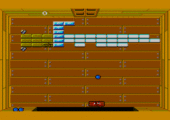
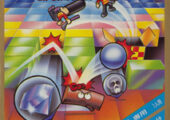
Megumi Rescue is the standout game of the lot. The other three exclusives have issues. For Woody Pop, this comes down to some poor level design and lackluster presentation, which is too bad because there is a bit to like about the game. Woody Pop offers a few appreciated enhancements over its Arkanoid inspiration. These can be minor improvements, such as having bricks which need multiple strikes to destroy visibly crack after hits (Arkanoid featured no such indicator), and major changes, such as offering branching paths to provide some additional diversity on a given playthrough. You’re given the choice after clearing a level, and each door offers a differing amount of bonus points which presumably is tied to the room’s difficulty… though I’ve not noticed much of a difference.
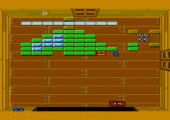
Sega also made sure Woody Pop had power-ups just like Arkanoid, and these are obtained by catching the small bubbles dropped from smashed crystal bricks. I especially like how some power-ups can be combined, and I was pleasantly surprised when I died due to having the glue item, which lets Woody catch the ball, active at the same time as the flames item, which sets the ball ablaze to burn bricks. Other items are fairly standard: Woody can double in size, there’s a diamond ball which can slice through anything, and a multiball bonus among others. I’d say the diamond bonus and the shot power-up, which lets Woody blast bricks without the ball just like the laser in Arkanoid, are by far the best ones to get and the key to a successful run.
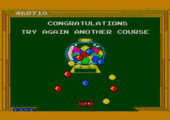
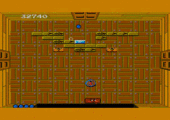
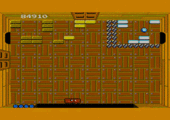
While Arkanoid is a very sleek if sterile looking game with 3-D modeled elements, Sega gave its clone more personality. Woody the Wood Spirit ventures through the Bizarre Mansion in order to rescue his friend, Gumball, and he does that by smashing all of the breakable bricks in each room, all the while glancing around and wincing when struck with a ball. It should be cute, but it’s not, and much of that is due to the squished paddle leaving little room for details and the dark brown coloring making those details difficult to see. In addition to Woody, the wood paneling throughout the mansion (this is the 80s, after all) bathes the screen in shades of brown and orange as well. It’s as if the Sega pawned its blue skies but soldiered on with development to pay off the debt. The artwork isn’t particularly good and is rather garish against the more vibrant brick colors generally on display. This would be a great candidate for a color mod if only someone cared about Woody Pop.
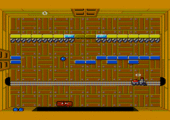
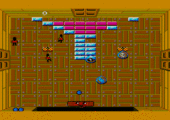
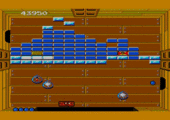
Unfortunately, a color mod would not be enough, because the level design needs work as well. Arkanoid was developed for a vertical display, but Woody Pop uses a shorter and wider playfield being a console game drawn to 4:3 scale. This means your paddle has to cover a lot more ground, which would be OK, except that the rapid increase in speed, even on the easier difficulty settings, makes that too difficult to be enjoyable. There are more obstacles near the lower half of the screen in Woody Pop than in Arkanoid, whether invincible blocks or moving trains, and they can effortlessly redirect balls into the pit below before most players would have a chance to react.
The extra screen space also allowed Sega to add occasional warp holes which sometimes will transport the ball to a completely secluded area of the room, and these can be quite tedious as there is no way to impact the trajectory of the ball once it bounces off Woody. This is standard for any block breaker game, but in Woody Pop, this can result in lengthy stretches of inactivity while you wait for the ball to bounce around dozens of times before it jars itself free and returns to the main playfield, now with a significant speed boost. Another headache are the toy box blocks which will release three tin robots or toy soldiers when struck. The boxes never go away, and each new strike will replenish the toys so that three enemies always remain on screen. The tin men may as well be sent by Skynet, endlessly mistaking Woody Pop for Sarah Connor, and though they only take one hit to dispatch, the endless waves remain a nuisance throughout.
Accompanying the aggravation is a soundtrack, which I can best describe is like listening to someone playing a different Master System game from across the room. Aside from a couple of jingles here and there, the “music” is just assorted sound effects, some tied to bouncing ball and others just randomly there for percussion, if I can call it that. I find it oddly interesting, and I half expected to see Motohiro Kawashima to have started here before moving onto Streets of Rage 3. I guess Sega recognized that its game was constantly tooting dinks and bloops which would have overpowered any music and just ran with that.
Google translates Woody Pop‘s Japanese subtitle as “Breaking the Blocks of the New Human Race,” which sounds vastly more interesting then the more accurate “New Generation Block Breaker.” Sega made a tepid attempt to advance the genre with Woody Pop, but none of the additions such as the level branching and warp points are implemented well enough to overcome the game’s flaws. I wouldn’t call Woody Pop a bad game but more a disappointing and forgettable one. I can sort of see it as a missing link between Arkanoid and Wizorb, but that feels too generous as most of the game’s deviations from Arkanoid never amount to much. Woody Pop is playable but never reaches the point of being something you’d go out of your way to play. You buy Woody Pop simply because it was the cheapest way to obtain the paddle controller, and I suspect Sega developed it with that in mind.
SCORE: 4 out of 10
Recent Comments