
Genre: Shmup Developer: Sega Ent. Publisher: Sega Ent. Players: 1-2 Released: 1988
For whatever reason, Sega assigned a star rating system to its SG-1000 and Mark III/Master System games. There’s no “seal of quality,” so these presumably would let consumers know the quality of the game they are buying. I don’t know what criteria Sega used to make these determinations, but the scale is extremely suspect. Most of the SG-1000 games have just two stars, even the better games for the system like Girl’s Garden. Woody Pop gets five stars, but Aleste can only manage four? It’s madness. These are the kinds of decisions which would have had me writing angry letters to Mr. Sega if I lived in Japan at the time.
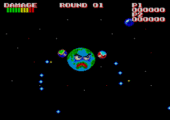
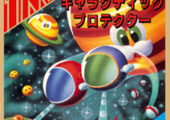
Galactic Protector is one of two standalone Sega paddle games and was given four stars, just one down from both mainline Fantasy Zone shooters. Expectations are high. The cover art is definitely enticing, showing the sentient ship brothers Opa-Opa and Upa-Upa, introduced in fellow four-star Opa Opa (Fantasy Zone: The Maze in the West), blasting away at asteroids while three planets quite literally look on. This tells of the game’s prevailing visual gag: giving the planets faces so they can react to their surroundings. They’ll exude fear when being attacked, anger when struck, and joy when the player is successful in repelling the threats.
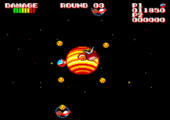
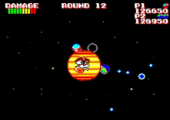
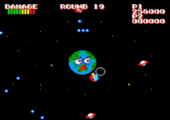
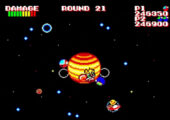
Each round slaps one large planet in the center of the screen. Opa-Opa and his brother, if joined by another player, are tethered to the planet and must orbit around it and shoot down various objects before they collide into the planet. The ships rotate smoothly around the circumference of the planet, but the planets’ expressions aren’t animated nearly as well, cycling through several images which look nice in stills but a little jerky in motion. The attacking clusters of asteroids and debris aren’t impressive in the least, being mostly a collection of small static images. They’ll all blow up when shot, but only one, the ninja star looking Shuri, has any animation during its attack.
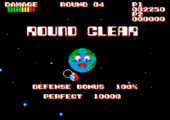
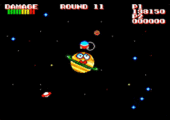
For a 1-Megabit cartridge, you’d expect more from the graphics. Galactic Protector throws the bulk of its memory into the nice title, ending, and game over screens; the player ship animation, and the planets with their varied faces. This choice presents the first big issue with the game as this severely limits the level variety. There are only three planets – Earth, Saturn, and Jupiter – and the game will cycle through them across its 25 stages. Each planet does have its own theme, though all three sound like variations of the same song. If you clear all targets in a round, the game plays its sole audio sample, what to me sounds like a pinched “Perfect Score!”, and I’m sure it represents a good bit of that memory, too. There are also no new enemy surprises, bosses, or anything of the sort to interest players through the end. You will be delivered power-ups over the course of the game, but that barely makes a dent in just how repetitive the gameplay is.
“Well, like, that’s no different than a lot of old scoring shooters.” That is true, except that Galactic Protector isn’t structured as well nor is it particularly fun to play. Each round starts with a damage meter displayed on the top-left of the screen, and the planet can take ten hits before dying. It’s counterintuitive to let enemy attacks through, but that’s exactly the best strategy for getting through the game, particularly in the first two rounds when Opa-Opa is stuck with his pea shooter. Once the power-ups start rolling in on Jupiter, the game becomes significantly easier to manage.
A second player would make things even easier, of course, and Galactic Protector is the only Mark III/Master System paddle game to support two-player co-op play. The brothers will overlap and pass through each other as they move around the planet, and you’ll probably find yourself dividing the screen in half to help minimize the number of threats each player has to subdue. It’s rare that a shooter is more fun to play in multi-player, but I think that applies to Galactic Protector as the challenge isn’t terrible nor made too distracting by having another ship present on screen.
This is where I struggle with the game because I don’t find the premise very fun given how restrictive the paddle control is in the game. Basically, there is an invisible wall at the six o’clock position, and you can never pass it. If an asteroid appears on the western side of the planet, you have to spin counterclockwise, three times the distance you’d expect to have to move from the south position, in order to shoot it. You can’t spin freely around the planet as you’d expect as in Tempest, and it’s incredibly jarring to play and is my second and biggest problem with Galactic Protector. The potentiometer powering the paddle controller is going to have defined end points as any other, but I don’t understand why Sega mapped that 1:1 to the movement in-game. Smaller ranges of input reading could have allowed for a number of loops around the planet before hitting the end which would have been more satisfying and is how it is done in other potentiometer games. It’s just shocking to have a game created specifically for the controller but use it so poorly.
Adding to that frustration is how erratic the enemy movements are in Galactic Protector. I would anticipate that with a premise of planetary defense and sticking said planet smack in the middle of the screen, the enemy objects would generally drift inward and orbit around from the edges except for maybe an odd UFO type of target. No, these asteroids dance. They’ll swirl around, then move in close, then move back out and take another lap before crashing down. Or they’ll make a beeline for the planet, making you think they’re a priority, only to stop on a dime and begin orbit. There is no recognizable patterns as there are with classic scoring shooters like Space Invaders, Asteroids, and the like; and the way they flit around just highlights how infuriating that invisible wall can be. The targets in Galactic Protector are at odds with the control scheme, which should be the highlight of the game, and it does not make for an enjoyable experience.
I should note that other versions of Galactic Protector don’t require the paddle controller. The PlayStation 2 version in Sega Ages 2500 Vol. 33 Fantasy Zone Complete Collection uses the analog stick for movement, and while it is more skittish, it does at least bypass the issue of the dead end. When it comes to the original game, however, I can adapt to the odd control implementation, knowing what can and cannot be done, but it never feels right. Galactic Protector in the strictest sense is I suppose a serviceable game with cute visuals, but as a title requiring the paddle controller, its poor usage of that device is a terrible misstep which basically ruins the game. “Mr. Sega, I loved your Fantasy Zone games on the Mark III, but I must implore you to reconsider your judgement following these last two installments. Opa Opa was odd and not what I wanted, and now this Galactic Protector game doesn’t feel well thought out at all. How are you giving this four stars? This is clearly not deserving of such a high rating! Please fix!”
SCORE: 3 out of 10

Recent Comments