
Genre: Shmup Developer: Sega Ent. Publisher: Sega Ent. Players: 1 Released: 1986
Choplifter, a classic video game initially developed by Dan Gorlin for the Apple II computer in 1982, launched a franchise that has shot up several Sega consoles over the years. Its journey from the Apple II to the Sega Master System in 1986 wasn’t the first time Sega fans got to experience the nerve-wracking mission to save hostages under enemy fire, as the company’s arcade arm, Sega Enterprises USA, debuted the arcade version alongside Hang-On in October 1985 as a conversion kit. It was programmed by the legendary Rikiya Nakagawa (Alien Syndrome, Thunderblade), who made a ton of refinements to the core gameplay. He dropped the number of hostages needing rescue from 16 to eight and added new stages, including a fleet of battleships and the infamous cave. These changes enhanced Choplifter significantly and made the game a wonderful candidate for a Master System conversion. One thing about the port that always perplexed me was the title screen, though. Why is the helicopter firing on the hostages? One likely answer is because the player made it to stage three, but more on that later on.
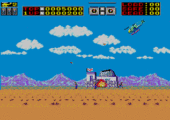
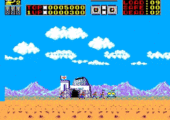
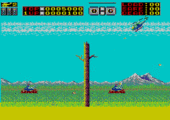
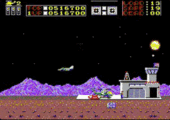
The basic premise of Choplifter was simple yet exhilarating: players took on the role of a helicopter pilot tasked with rescuing hostages from various perilous situations across six stages (actually three stages looped twice) consisting of three environments – desert, ocean, and cave – while destroying obstacles to free them. There were multiple steps to this process, starting with carefully navigating the helicopter down for retrieval while avoiding inadvertently harming them (yes, one could indeed kill the very people one had come to save). Reaching the innocent was just the beginning. Once the helicopter landed, the hostages had to run to it and board while the enemy did its best to kill everyone. Then, players had to make the trip back to safety. The challenge came from the fact that the farther one went to rescue hostages, the longer the return trip to base was. It took 40 hostages to move onto the next stage, so while there was some wiggle room for a lost helicopter, it wasn’t much.
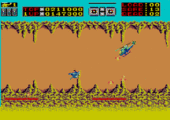
At only three stages, Choplifter was brief but still managed to build up tension and challenge by progressively increasing in difficulty as players advanced through enemy fire and natural hazards. There were no traditional bosses, but the game compensated by introducing challenging adversaries like hovering airships and unpredictable physical obstacles. Each level presented a new set of barriers to overcome, like flying low to avoid stalactites in the cave while not going low enough to become an easy target for enemy ground forces. It took some time to get used to the helicopter’s control, but once you did, you would be singing “The Ride of the Valkyries” in no time.
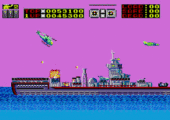
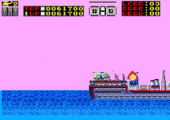
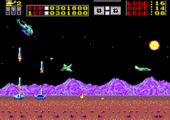
Blowing stuff up is always fun, but it’s often not enough to make a game worthwhile. Perhaps to compensate for Choplifter’s short length, Sega made it quite hard (more on that in a bit) and wrapped its simple gameplay in some excellent presentation, making excellent use of the Master System’s color palette and adding some great parallax scrolling to the backgrounds. I also love how the hostages jumped up and down in anger if the helicopter took off without them in stages one and three and swam from the submarine to the helicopter in stage two. Sega also included some neat bonuses, like Superman and even E.T. appearing in stages if players destroyed 16 rockets.
While Choplifter offered a nostalgic trip down memory lane, it wasn’t without its shortcomings. The game’s brevity and steep difficulty curve, particularly evident in the later stages, undoubtedly left some players craving more content. Stage three (cave) was a major offender because of how crapped and suffocating it was. It required a lot of practice to memorize the location and patterns of enemy vehicles and natural dangers, meaning that there would be a lot of do-overs. I understand that many arcade games of the era were designed that way deliberately to maximize quarter munching, but the home version was equally unforgiving for new players. My gripe is not a major one though, and I know why I rented Choplifter so often back in the day. With time, the game became easier, but that led to another problem, the aforementioned length. Once you mastered all three stages, Choplifter could be beaten in under 15 minutes. As I said, the stages did loop, and stage one even had a cool night transition, but they still had the same layout and goal as the first time through. More stages would have given the game longer legs. Additionally, the absence of boss encounters, although not detrimental to the overall experience, could have extended the game’s play time while adding another layer of excitement. I always think of the ending of Rambo: First Blood Part 2 (the movie, not the Master System game) when playing, and it would have been interesting to have that final enemy to defeat before chugging home in a damaged chopper.
Despite these minor drawbacks, Choplifter on Master System remains a timeless classic that continues to be fun today in short bursts. Although not as visually vibrant, the addition of the new stages makes it an improvement over the arcade version and one of the best home ports out there. Its unique blend of rescue missions, intense gameplay, and intense action should earn it a place in anyone’s Master System library. Whether you’re reliving childhood memories or experiencing it for the first time, Choplifter is a must-play for anyone seeking for some tense, old school arcade action.
Choplifters of the world unite and take over!
SCORE: 8 out of 10
Recent Comments