
Genre: Puzzle Developer: Sega CS1 Publisher: Sega Ent. Players: 1-2 Released: 1991
Back before the party games, the fighters, the educational spin-offs, the based-off-those-same-puzzles games, and all the other off-shoots of the Sonic franchise, there was a Sega block matching game, Sonic Eraser. It’s considered an oddity and was first released during Sega’s first forays into online distribution, a then-rare effort that was only available in Japan. A simple block matching game, it’s one of the Blue Blur’s first attempts at tackling other genres, and it’s also a loose tie-back to his early merchandising days.
Sonic Eraser is inarguably a game with a history. Along with a small batch of other titles, it was released on the Japanese Mega Drive subscription-based Game Toshokan streaming service for the Mega Modem that allowed console players to compete in online matches. Titles like the Phantasy Star II text games and Fatal Labryinth were low-tier, simple games that could be downloaded and played while the console was powered on. Ambitious as it was, online gaming was still in its infancy, and the streaming service had a small user-base. Sonic Eraser and other titles thus faded into obscurity once the Game Toshokan service was discontinued in 1992.
Sonic Eraser was thus condemned to a brief existence of isolation in its native country. An official Western release never materialized, leaving the game locked away for just over a decade. In 2004, a dedicated fan community finally became aware of Sonic Eraser when Sega of Japan added it to its B-Club download service, which let players download some Mega Drive games directly from its website. A planned inclusion in Sonic Gems Collection didn’t pan out, but fans were able to translate the ROM into English, and Sonic Eraser was finally freed to move westward where a new generation of players could now play it. Sadly, that unofficial release remains the only way for most players around the world to get a glimpse of the game.
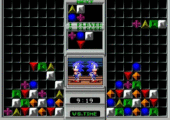
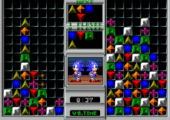
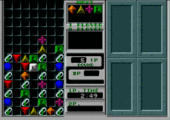
The gameplay is pretty familiar if you’re a fan of the puzzle genre: you arrange falling shapes to clear the screen for as long as you can, and like Columns, players fight to outlast their opponent, either the computer or a second player, instead of just chasing a high score. The pieces come in clusters of four and resemble the classic shapes from Tetris, except for the “zig-zag” pieces. Sonic Eraser is a bit more forgiving than Columns in that it only requires matching two or more identical blocks to make them disappear instead of three. It also has the occasional mystery pieces that will eliminate any blocks they touch.
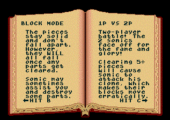
I do admit that for such an early puzzle game (the first to feature Sonic), Sonic Eraser makes a decent effort to add some structure beyond this basic design by including four different game modes. Round Mode is the basic option and offers 40 stages of score-driven play where the clusters fall faster as they improve, and players must clear spiral rings sprinkled among the other shapes to clear the board by removing all the other shapes around them. Normal Mode is much less stressful. Instead of being able to create a chain, players focus primarily on scoring, with the difficulty level increasing as they get better. In Doubt Mode, some pieces turn into white squares after landing, forcing players to adapt on the fly. Lastly, Block Mode allows builds of tall, unstable stacks designed to collapse into dramatic chain reactions but that can topple with a single misstep. Each mode also adds some element of surprise by adding items that will not be visible until they have landed. You have to adjust quickly once these new items appear on the board. The final play style allows players to create chain reactions by stacking items in high-risk areas; however, you’re also penalized sharply if you make a mistake.
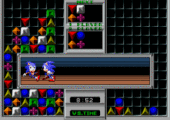
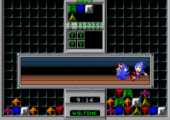
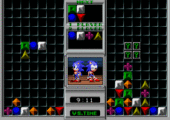
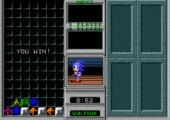
Sonic Eraser also has a decent competitive option, either against the computer or another player. For instance, instead of facing a typical opponent, you go up against your opponent’s Sonic avatar. As blocks start to vanish, you can unleash attacks like punches, spin dashes, and spin dashes while using a temporary shield. All these moves have the same effect: they briefly paralyze the rival. When the opposing Sonic is stunned, they can’t rotate or place pieces, which can lead to a quick defeat if several rows pile up during that moment of vulnerability. This mechanic makes bouncing back from setbacks surprisingly tough. A stun lasts several seconds, which is often just enough time for the computer to build momentum and hit again right after. A few waves of blocks during this weak point can easily overwhelm you, especially when the stack gets close to the top of the screen.
I know many people look at screenshots of Sonic Eraser and think that the presentation is kind of lean, but that’s something I suppose one should expect from such an early downloadable game. Sega went with a simple formula to keep the game light in ROM size, and there’s not a lot of original graphical content here. The visuals lean heavily on existing Sonic animations, while the new artwork and simple geometric blocks feel a bit rough around the edges. The audio is quite basic, featuring minimal sound effects and just a single background track that many players might find hard to enjoy. There isn’t any of the catchy Sonic themes from the first game, which I think would have added a bit more connection, given that the franchise was just beginning to take off.
I think that’s perhaps the biggest problem with Sonic Eraser. It doesn’t really feel like a Sonic game at all. It’s a capable puzzle title, but not one that needed the character to be so. Sonic seems added in just to make players on the Toshokan service play it. There’s enough meat on the bones of the design to make a solid foundation for a deeper puzzle game, but Sega seemed content with making something just playable enough to warrant those subscription payments each month. Sonic Eraser never had a sequel or even an updated release. Hell, it never had another release in Japan aside from the B-Service one, and it was completely kept from western audiences. I guess Sega thought that it did its job and wasn’t needed anymore. That’s a shame, as there’s some potential here that was sadly never given the chance to grow and develop.
And that’s about it. Even with smooth controls, Sonic Eraser’s limitations make it more of a curiosity than a standout in the franchise. The multi-player feature adds some fun and is probably the mode that will get the most play, as both players might get a kick out of watching two Sonics duke it out amid falling blocks. Beyond that, the overall basic nature of Sonic Eraser’s design keeps it firmly in “historical footnote” territory. For many fans, its main draw will probably lie in the novelty of experiencing one of the rarest entries in Sonic’s long list of spin-offs. For more serious puzzle fans, I recommend Columns or Dr. Robotnik’s Mean Bean Machine instead.
SCORE: 5 out of 10

Recent Comments